
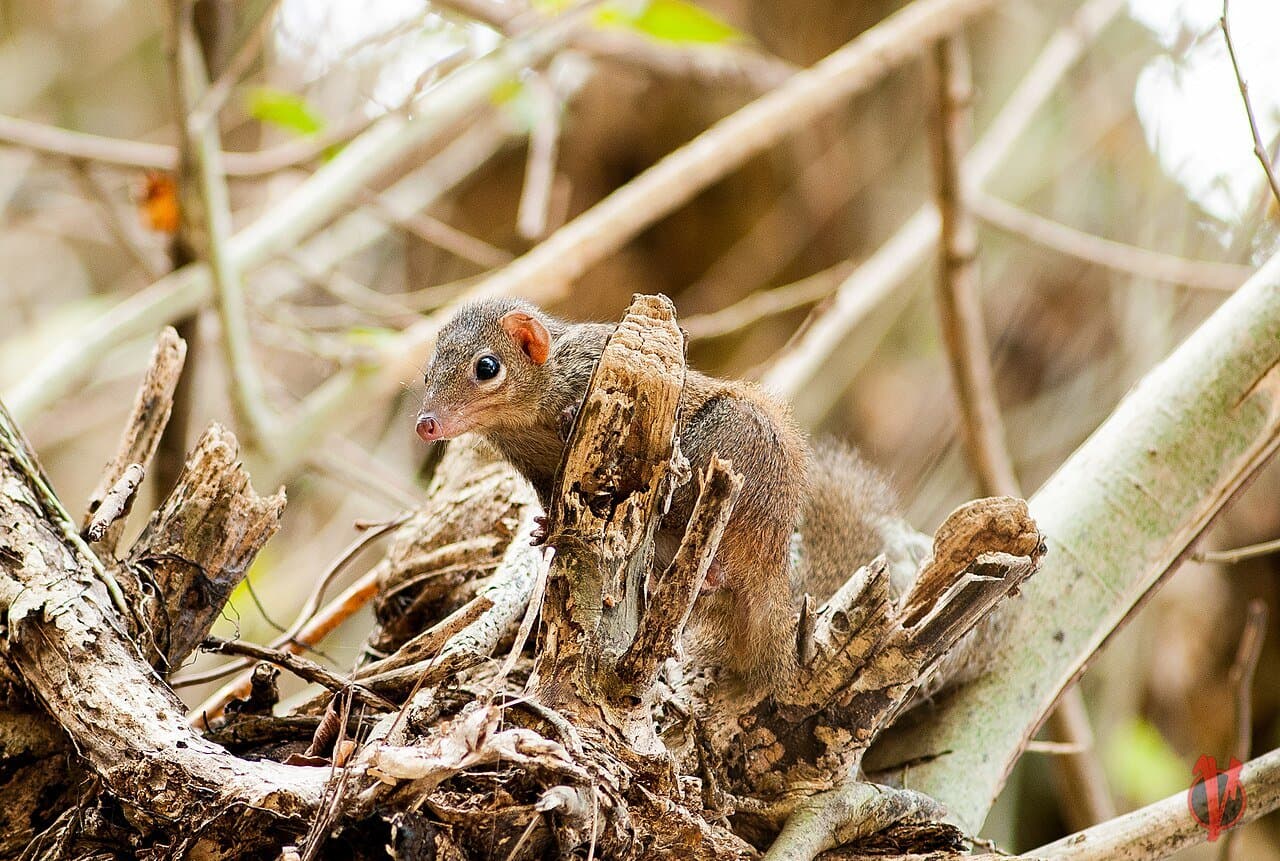
Northern Tree Shrew
Tupaia belangeri
A squirrel-like mammal from Southeast Asian rainforests that belongs to its own unique order of mammals.
Checking teacher reviews…
About the Northern Tree Shrew
Northern tree shrews have a head and body 5.5 to 9 inches long and a tail about as long as the body. They live in rainforests across Southeast Asia, from Nepal and Bangladesh to southern China and the Malay Peninsula. Though they can climb, they spend most of their time on or near the ground, hunting small prey in the leaf litter. They mark their territories with scent glands on the belly and chin.[1]
Quick facts
- Scientific name
- Tupaia belangeri[1]
- Size
- Head and body 5.5 to 9 inches; tail about the same length.[1]
- Diet
- Small prey found in leaf litter, plus nectar from pitcher plants.[1]
- Habitat
- Rainforests, mostly on or near the ground.[1]
- Where it lives
- Southeast Asia, from eastern Nepal and Bangladesh to southeastern China, Indochina and the Malay Peninsula.[1]
- Group life
- Small family groups. Active during the day.[1]
- Babies
- Usually 2 young after a 40- to 52-day pregnancy.[1]
- Conservation status
- Least Concern (IUCN Red List, assessed 2023).[2]
Fun facts
Vocabulary
- symbiosis
- A close relationship between two different kinds of living things that often helps both.
- pitcher plant
- A plant with tube-shaped leaves that trap and digest insects.
- territory
- An area an animal claims and defends.
- diurnal
- Active mainly during the day.
- least concern
- A conservation label meaning a species is widespread and not at risk of dying out soon.
See it in person
- Smithsonian's National ZooWashington, D.C. · Small Mammal HouseSee this animal on the zoo's website ↗
These zoos had this animal when we gathered our information, but animals sometimes move. Check the zoo's website or contact the zoo before you visit.
Sources
- [1] Smithsonian's National Zoo & Conservation Biology Institute. “Northern tree shrew.” https://nationalzoo.si.edu/animals/northern-tree-shrew (accessed 2026-10-08)
- [2] IUCN Red List of Threatened Species. “Tupaia belangeri (Northern Treeshrew).” https://www.iucnredlist.org/species/41492/229775933 (accessed 2026-10-08)
Facts last checked 2026-10-08.


