
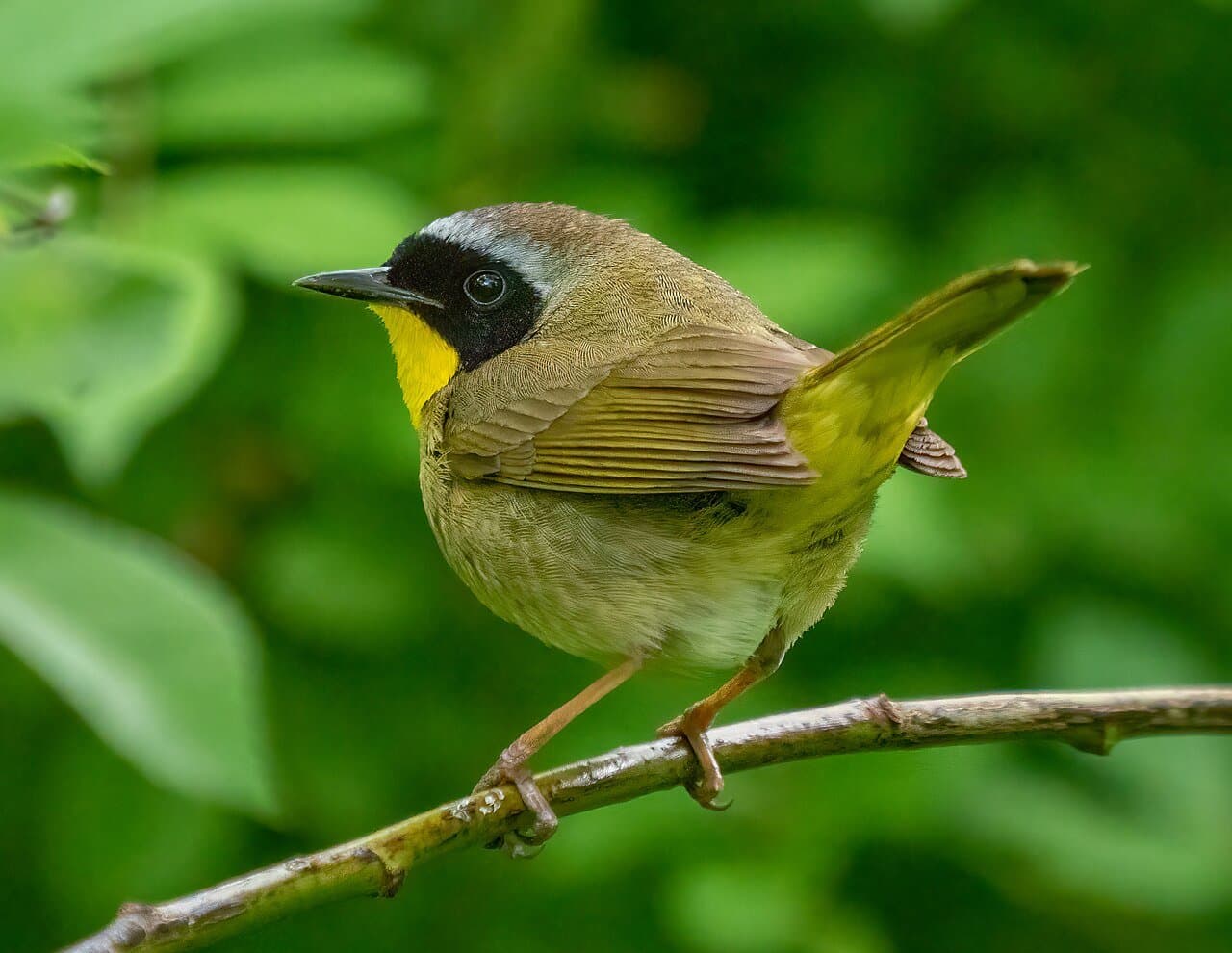
Common Yellowthroat
Geothlypis trichas
A small marsh warbler whose males wear a black 'bandit' mask and sing 'witchety-witchety-witchety.'
Checking teacher reviews…
About the Common Yellowthroat
Common yellowthroats are 4.3 to 5.1 inches long and weigh about a third of an ounce. Males have bright yellow throats and a black mask; females are plainer but also have yellow throats. They spend summer across the United States and Canada in swamps, marshes and along streams with thick plants. They eat mostly insects, picking them from leaves or catching them in the air, and add fruit in winter.[1]
Quick facts
- Scientific name
- Geothlypis trichas[1]
- Size
- 4.3 to 5.1 inches long.[1]
- Weight
- About a third of an ounce.[1]
- Lifespan
- Usually 1 or 2 years; up to 11.[1]
- Diet
- Mostly insects; more fruit in winter.[1]
- Habitat
- Swamps, marshes, stream banks and thickets.[1]
- Where it lives
- Summers across the United States and Canada.[1]
- Group life
- Pairs when breeding; alone in winter. Active by day.[1]
- Babies
- Creamy, spotted eggs, incubated for about two weeks.[1]
- Conservation status
- Least Concern (IUCN Red List, assessed 2020).[2]
Fun facts
Vocabulary
- warbler
- A small, often colorful songbird that eats insects.
- marsh
- A wet, grassy area that is often flooded.
- territory
- An area an animal claims and defends.
- migrate
- To travel from one region to another with the seasons.
- least concern
- A conservation label meaning a species is widespread and not at risk of dying out soon.
See it in person
- Smithsonian's National ZooWashington, D.C. · Bird HouseSee this animal on the zoo's website ↗
These zoos had this animal when we gathered our information, but animals sometimes move. Check the zoo's website or contact the zoo before you visit.
Sources
- [1] Smithsonian's National Zoo & Conservation Biology Institute. “Common yellowthroat.” https://nationalzoo.si.edu/animals/common-yellowthroat (accessed 2026-10-08)
- [2] IUCN Red List of Threatened Species. “Geothlypis trichas (Common Yellowthroat).” https://www.iucnredlist.org/species/22721836/137315462 (accessed 2026-10-08)
Facts last checked 2026-10-08.
More Songbirds
 Bali MynahLeucopsar rothschildi
 Baltimore OrioleIcterus galbula
 Black-and-white WarblerMniotilta varia
 Black-throated Green WarblerSetophaga virens
 Blue GrosbeakPasserina caerulea
 Carolina WrenThryothorus ludovicianus
 Cedar WaxwingBombycilla cedrorum
 Crested OropendolaPsarocolius decumanus
 Grasshopper SparrowAmmodramus savannarum
 Gray CatbirdDumetella carolinensis
 Green JayCyanocorax yncas
 Indigo BuntingPasserina cyanea
 Magnolia WarblerSetophaga magnolia
 Northern MockingbirdMimus polyglottos
 Orchard OrioleIcterus spurius
 OvenbirdSeiurus aurocapilla
 Painted BuntingPasserina ciris
 Palm WarblerSetophaga palmarum
 Red-eyed VireoVireo olivaceus
 Red-winged BlackbirdAgelaius phoeniceus
 Rose-breasted GrosbeakPheucticus ludovicianus
 Scarlet TanagerPiranga olivacea
 Song SparrowMelospiza melodia
 Superb StarlingLamprotornis superbus
 Swainson's ThrushCatharus ustulatus
 Taveta Golden WeaverPloceus castaneiceps
 Tennessee WarblerLeiothlypis peregrina
 Turquoise TanagerTangara mexicana
 White-throated SparrowZonotrichia albicollis
 Wood ThrushHylocichla mustelina
 Yellow-breasted ChatIcteria virens
 Yellow-Rumped CaciqueCacicus cela
 Yellow-rumped WarblerSetophaga coronata