
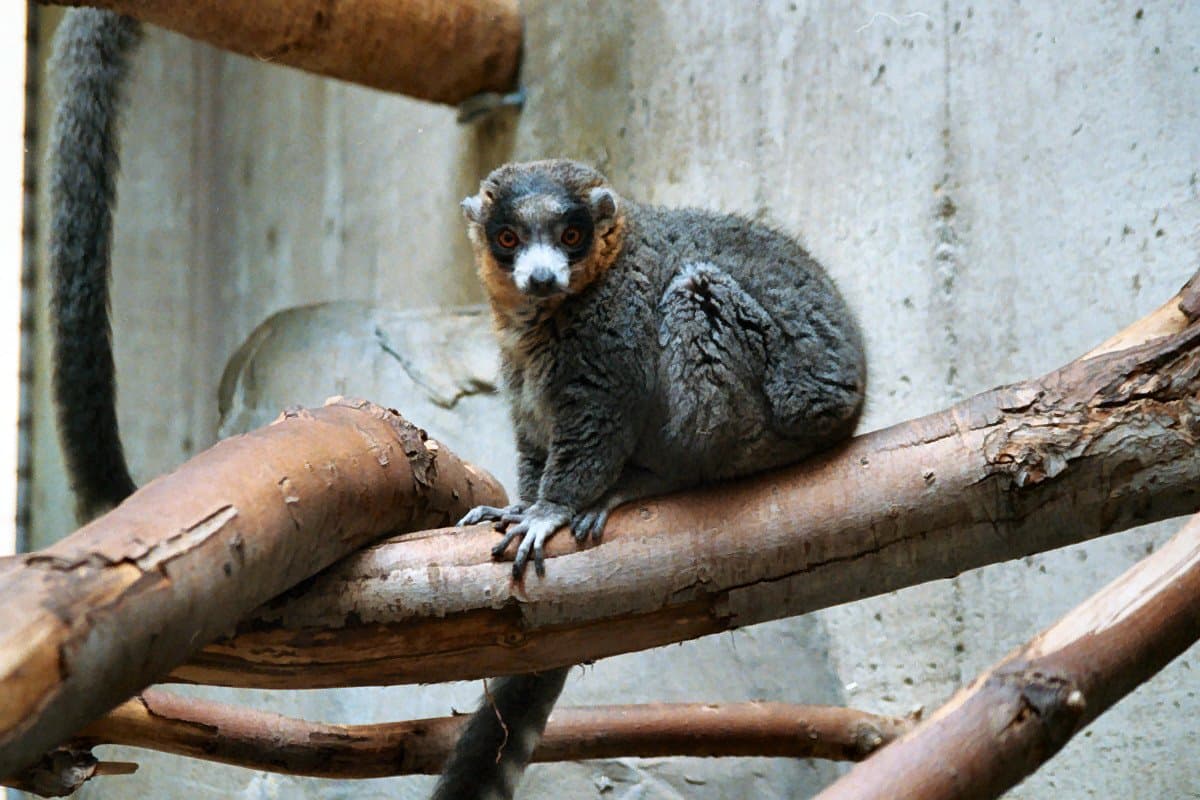
Mongoose Lemur
Eulemur mongoz
A small, gray, critically endangered lemur of northwestern Madagascar and the Comoro Islands that can switch between day and night activity.
Checking teacher reviews…
About the Mongoose Lemur
Mongoose lemurs live in dry forests of northwestern Madagascar and in humid forests on the Comoro Islands of Mohéli and Anjouan. They weigh 4 to 7 pounds, with a body about 14 inches long and a bushy tail about 19 inches long. Males are gray with red cheeks and beards, and females are darker gray with white cheeks. They eat flowers, pollen, fruit and leaves.[1]
Quick facts
- Scientific name
- Eulemur mongoz[1]
- Size
- Body about 14 inches; tail about 19 inches.[1]
- Weight
- 4 to 7 pounds.[1]
- Diet
- Flowers, pollen, fruit and leaves.[1]
- Habitat
- Dry forests in Madagascar; humid forests on the Comoro Islands.[1]
- Where it lives
- Northwestern Madagascar and the Comoro Islands.[1]
- Group life
- Families of 3 or 4. Females usually dominant.[1]
- Babies
- Usually one baby a year; twins are not rare.[1]
- Conservation status
- Critically Endangered (IUCN Red List, assessed 2018).[2]
Fun facts
Vocabulary
- lemur
- A primate found in the wild only on Madagascar.
- dichromatic
- Having males and females of different colors.
- nocturnal
- Active mainly at night.
- pollen
- A fine powder made by flowers.
- critically endangered
- A conservation label meaning a species faces an extremely high risk of dying out in the wild.
See it in person
- Omaha's Henry Doorly Zoo and AquariumOmaha, Nebraska · Hubbard Expedition MadagascarSee this area on the zoo's website ↗
These zoos had this animal when we gathered our information, but animals sometimes move. Check the zoo's website or contact the zoo before you visit.
Sources
- [1] Animal Diversity Web, University of Michigan. “Mongoose lemur (Eulemur mongoz).” https://animaldiversity.org/accounts/Eulemur_mongoz/ (accessed 2026-10-02)
- [2] IUCN Red List of Threatened Species. “Eulemur mongoz (Mongoose Lemur).” https://www.iucnredlist.org/species/8202/115561431 (accessed 2026-10-02)
Facts last checked 2026-10-02.
More Lemurs
 Aye-AyeDaubentonia madagascariensis
 Black-and-White Ruffed LemurVarecia variegata
 Blue-Eyed Black LemurEulemur flavifrons
 Coquerel's SifakaPropithecus coquereli
 Crowned LemurEulemur coronatus
 Gray Mouse LemurMicrocebus murinus
 Red Ruffed LemurVarecia rubra
 Red-Fronted Brown LemurEulemur rufifrons
 Ring-Tailed LemurLemur catta