
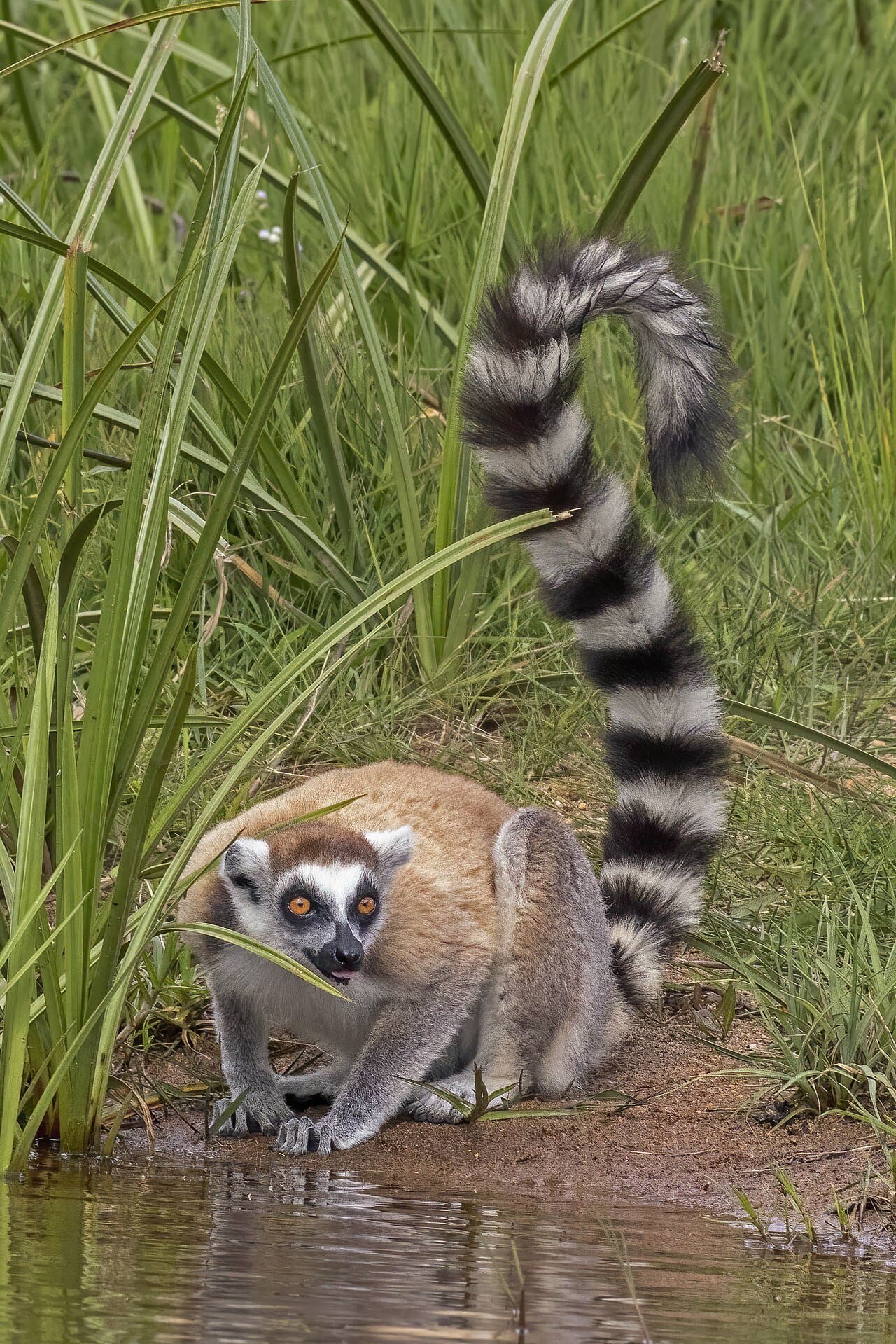
Ring-Tailed Lemur
Lemur catta
An endangered primate of southwestern Madagascar with a black-and-white striped tail, female-led troops and a love of sunbathing.
Checking teacher reviews…
About the Ring-Tailed Lemur
Ring-tailed lemurs live in dry, open areas and forests of southwestern Madagascar. They live in troops of 3 to 25, and females are in charge: they get first pick of food. Lemurs spend about 40 percent of their time on the ground. They sunbathe with their bellies toward the sun in a pose some people call the "yoga position." They eat leaves, flowers and insects, plus fruit and herbs.[1]
Quick facts
- Scientific name
- Lemur catta[1]
- Size
- Tail up to 2 feet (61 cm) long, with 13 black and white bands.[1]
- Weight
- Adult males average about 6 pounds (3 kg).[1]
- Lifespan
- About 16 years.[1]
- Diet
- Leaves, flowers and insects, plus fruit, herbs and small vertebrates.[1]
- Habitat
- Dry, open areas and forests.[1]
- Where it lives
- Southwestern Madagascar.[1]
- Group life
- Troops of 3 to 25. Females are dominant.[1]
- Babies
- Pregnancy lasts about 4.5 months. Babies cling to the mother's belly, then ride on her back.[1]
- Conservation status
- Endangered (IUCN Red List, assessed 2018).[3]
Fun facts
Vocabulary
- troop
- A group of lemurs, monkeys or other primates that live together.
- dominant
- In charge, or having first choice of food and mates.
- scent gland
- A spot on the body that gives off a smell animals use to communicate.
- Madagascar
- A large island off the southeast coast of Africa.
- endangered
- A conservation label meaning a species faces a very high risk of dying out in the wild.
See it in person
- Montgomery ZooMontgomery, Alabama · South AmericaSee this area on the zoo's website ↗
- Zoo AtlantaAtlanta, Georgia · All AnimalsSee this animal on the zoo's website ↗
- San Francisco Zoo & GardensSan Francisco, California · MammalsSee this animal on the zoo's website ↗
- Omaha's Henry Doorly Zoo and AquariumOmaha, Nebraska · Hubbard Expedition MadagascarSee this area on the zoo's website ↗
- Oakland ZooOakland, California · Children's ZooSee this animal on the zoo's website ↗
These zoos had this animal when we gathered our information, but animals sometimes move. Check the zoo's website or contact the zoo before you visit.
Sources
- [1] Smithsonian's National Zoo & Conservation Biology Institute. “Ring-tailed lemur.” https://nationalzoo.si.edu/animals/ring-tailed-lemur (accessed 2026-10-02)
- [2] San Diego Zoo Wildlife Alliance. “Lemur.” https://animals.sandiegozoo.org/animals/lemur (accessed 2026-10-02)
- [3] IUCN Red List of Threatened Species. “Lemur catta (Ring-tailed Lemur).” https://www.iucnredlist.org/species/11496/115565760 (accessed 2026-10-02)
Facts last checked 2026-10-02.
More Lemurs
 Aye-AyeDaubentonia madagascariensis
 Black-and-White Ruffed LemurVarecia variegata
 Blue-Eyed Black LemurEulemur flavifrons
 Coquerel's SifakaPropithecus coquereli
 Crowned LemurEulemur coronatus
 Gray Mouse LemurMicrocebus murinus
 Mongoose LemurEulemur mongoz
 Red Ruffed LemurVarecia rubra
 Red-Fronted Brown LemurEulemur rufifrons