
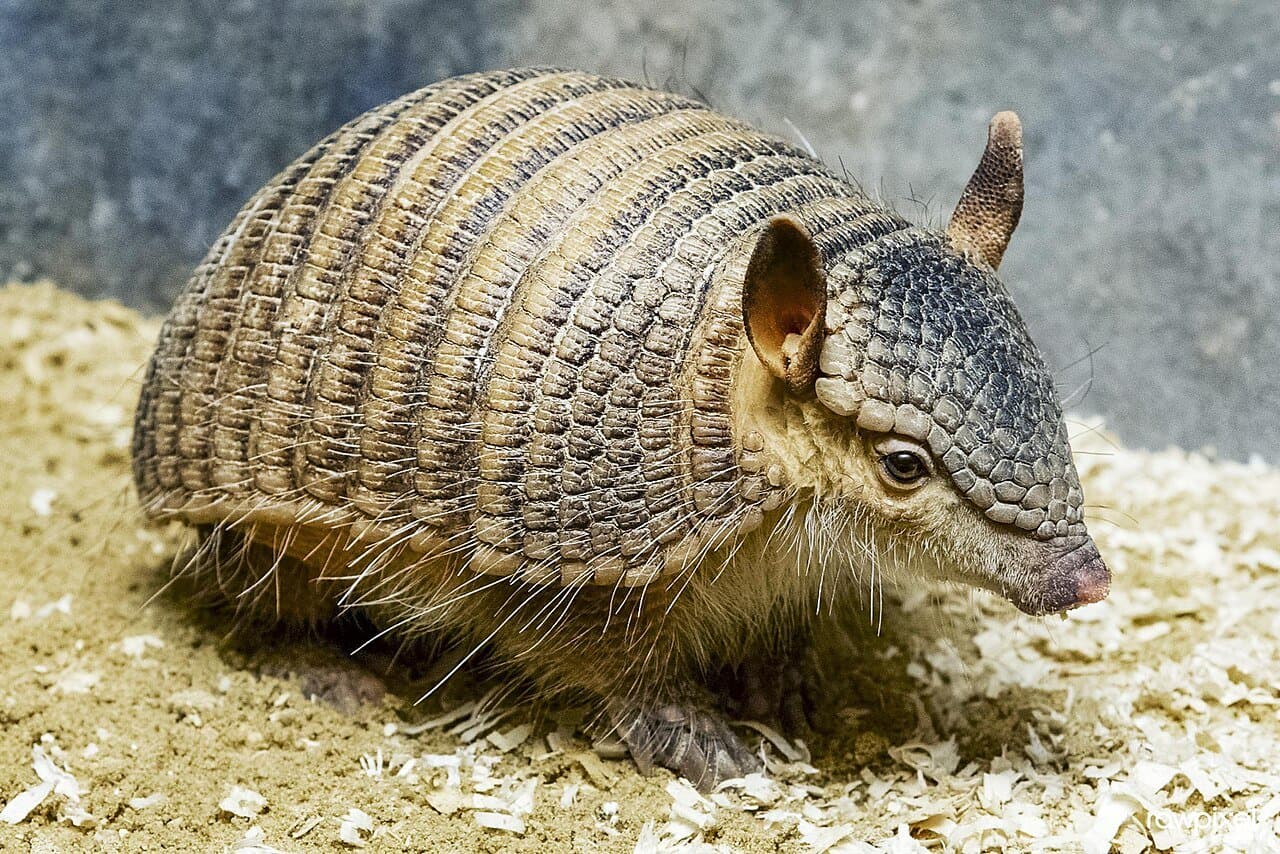
Screaming Hairy Armadillo
Chaetophractus vellerosus
A small, hairy South American armadillo that squeals loudly when it is threatened.
Checking teacher reviews…
About the Screaming Hairy Armadillo
Screaming hairy armadillos are the smallest of the hairy armadillos, weighing less than 2 pounds and measuring 8.7 to 15.7 inches long, plus a short tail. Their armor is made of bony plates covered with scales. They live in the Monte Desert of Argentina, Bolivia and Paraguay, where loose, sandy soil makes digging easy. They eat plants, insects and small animals like frogs, lizards and rodents.[1]
Quick facts
- Scientific name
- Chaetophractus vellerosus[1]
- Size
- 8.7 to 15.7 inches long, plus a 3.5- to 6.9-inch tail.[1]
- Weight
- Less than 2 pounds.[1]
- Lifespan
- Up to 8 or 9 years in human care.[1]
- Diet
- Omnivore. Plants, seed pods, insects and small animals such as frogs, lizards, birds and rodents.[1]
- Habitat
- Dry areas with loose, sandy soil, including dunes, savannas and pastures.[1]
- Where it lives
- The Monte Desert east of the Andes, in Argentina, Bolivia and Paraguay.[1]
- Group life
- Solitary.[1]
- Babies
- 2 or 3 young once a year after a 60- to 75-day pregnancy.[1]
- Conservation status
- Least Concern (IUCN Red List, assessed 2024).[2]
Fun facts
Vocabulary
- armor
- A hard covering that protects the body.
- scute
- A bony plate or scale on an animal's skin or shell.
- burrow
- A hole or tunnel an animal digs to live in.
- omnivore
- An animal that eats both plants and other animals.
- least concern
- A conservation label meaning a species is widespread and not at risk of dying out soon.
See it in person
- Smithsonian's National ZooWashington, D.C. · Small Mammal HouseSee this animal on the zoo's website ↗
These zoos had this animal when we gathered our information, but animals sometimes move. Check the zoo's website or contact the zoo before you visit.
Sources
- [1] Smithsonian's National Zoo & Conservation Biology Institute. “Screaming hairy armadillo.” https://nationalzoo.si.edu/animals/screaming-hairy-armadillo (accessed 2026-10-08)
- [2] IUCN Red List of Threatened Species. “Chaetophractus vellerosus (Screaming Hairy Armadillo).” https://www.iucnredlist.org/species/89604632/278015597 (accessed 2026-10-08)
Facts last checked 2026-10-08.


