
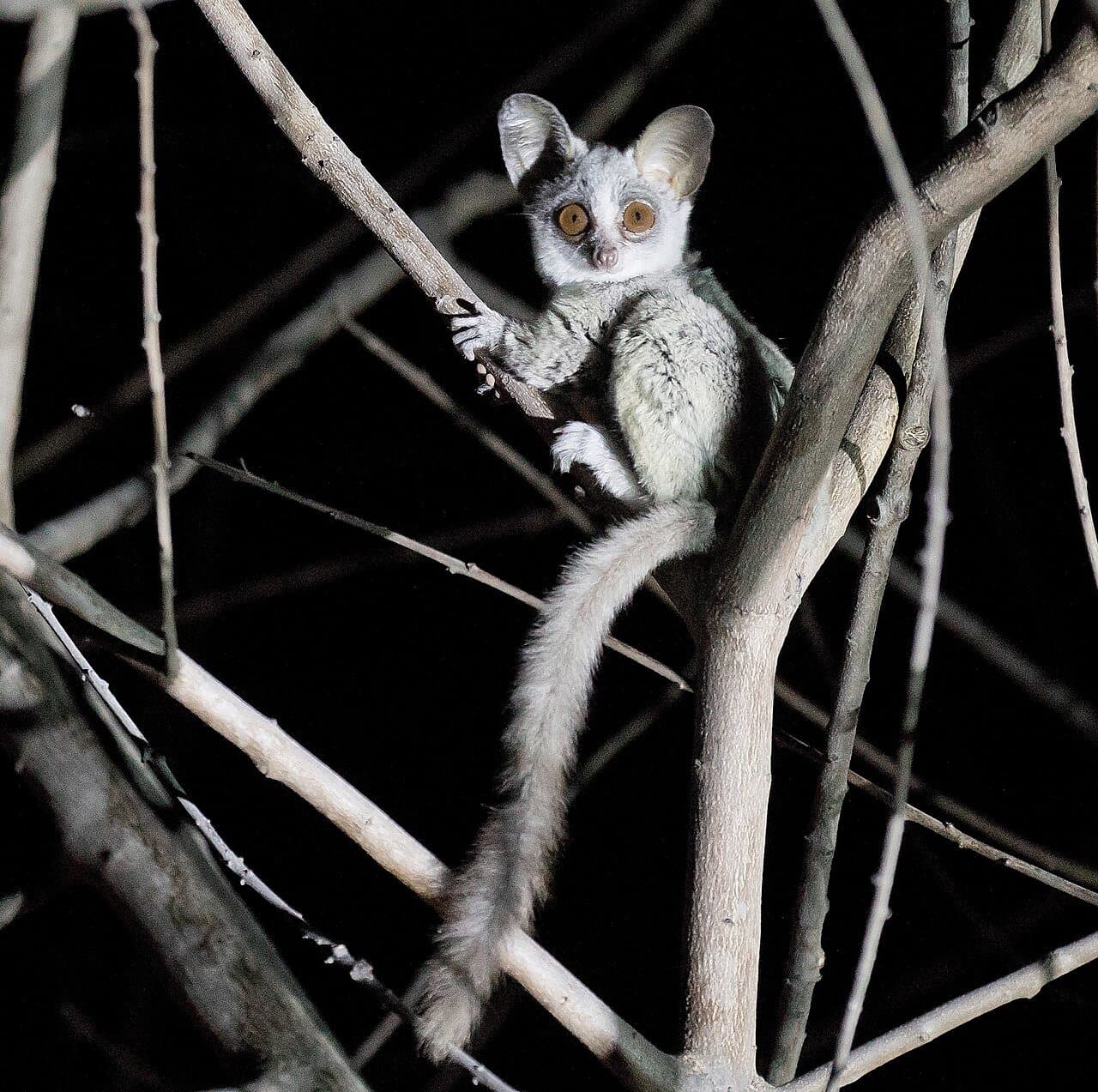
Southern Lesser Galago
Galago moholi
A tiny, big-eyed southern African bushbaby that leaps through trees at night and loves tree gum.
Checking teacher reviews…
About the Southern Lesser Galago
Southern lesser galagos are about the size of a large squirrel, with a 6-inch body and a tail up to 9 inches long. Their big orange eyes give them excellent night vision. They live in savanna woodlands of southern Africa, often near acacia trees, whose gum they love. They eat insects like moths and beetles, plus tree gum and fruit. They call to each other with chirps, barks, clicks and hoots.[1]
Quick facts
- Scientific name
- Galago moholi[1]
- Size
- Body about 6 inches; tail up to 9 inches.[1]
- Lifespan
- Up to 16 years.[1]
- Diet
- Insects such as moths and beetles, plus tree gum and fruit.[1]
- Habitat
- Savanna woodlands, often near acacia trees.[1]
- Where it lives
- Southern Africa.[1]
- Group life
- Pairs or small family groups; forages alone. Nocturnal.[1]
- Babies
- Usually twins, up to twice a year.[1]
- Conservation status
- Least Concern (IUCN Red List, assessed 2021).[2]
Fun facts
Vocabulary
- acacia
- A thorny tree common in African savannas.
- gum
- A sticky substance that oozes from some trees.
- nocturnal
- Active mainly at night.
- arboreal
- Living mostly in trees.
- least concern
- A conservation label meaning a species is widespread and not at risk of dying out soon.
See it in person
- Smithsonian's National ZooWashington, D.C. · Small Mammal HouseSee this animal on the zoo's website ↗
These zoos had this animal when we gathered our information, but animals sometimes move. Check the zoo's website or contact the zoo before you visit.
Sources
- [1] Smithsonian's National Zoo & Conservation Biology Institute. “Southern lesser galago.” https://nationalzoo.si.edu/animals/southern-lesser-galago (accessed 2026-10-08)
- [2] IUCN Red List of Threatened Species. “Galago moholi (Southern Lesser Galago).” https://www.iucnredlist.org/species/8788/206563837 (accessed 2026-10-08)
Facts last checked 2026-10-08.

