
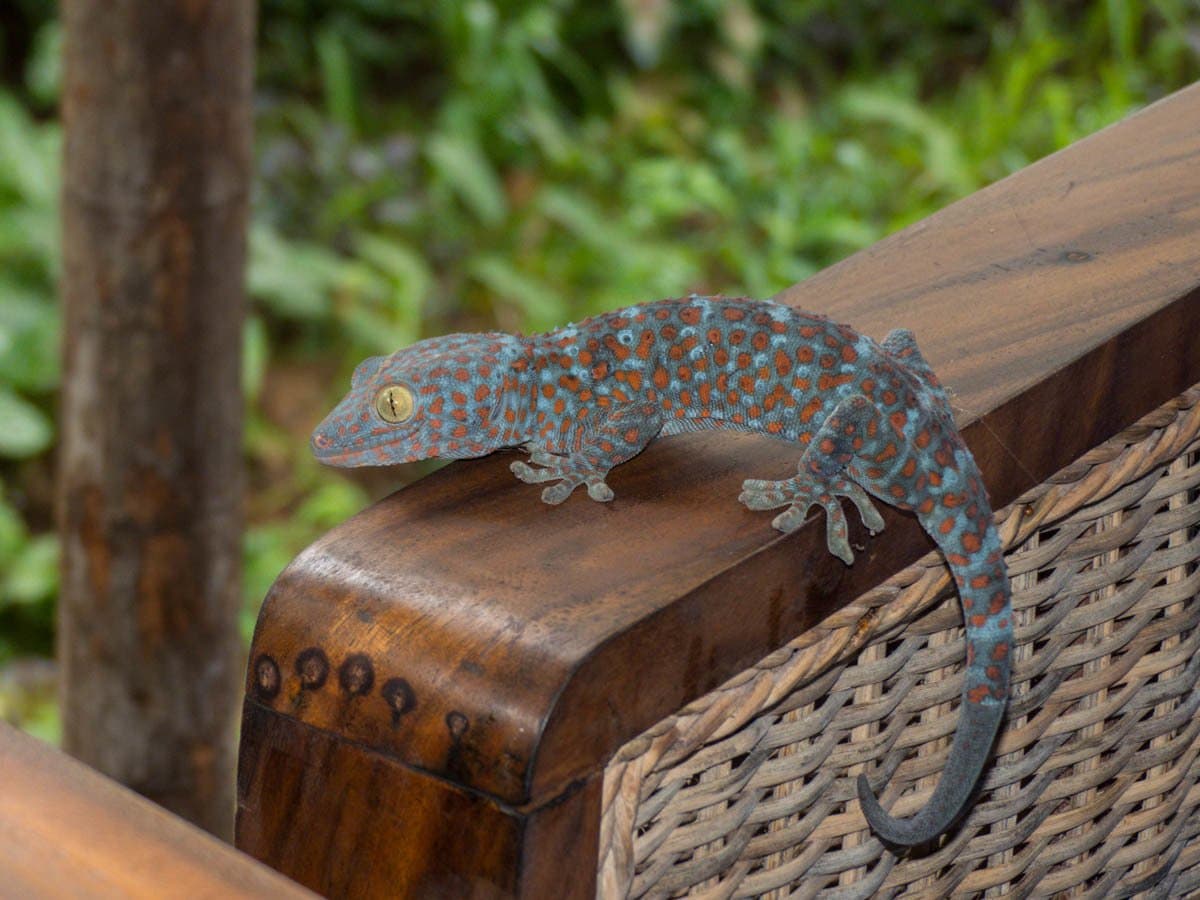
Tokay Gecko
Gekko gecko
A big, spotted Asian gecko named for its loud 'to-kay' call; it often lives in houses and eats insect pests.
Checking teacher reviews…
About the Tokay Gecko
Tokay geckos are among the largest geckos: males are 13 to 16 inches long and females 8 to 12 inches. They have thick bodies covered with red or black spots. They live in South and Southeast Asia, often near people, where they help control insect pests. At night they eat moths, grasshoppers, beetles, cockroaches, crickets and spiders, and sometimes small mice and snakes.[1]
Quick facts
- Scientific name
- Gekko gecko[1]
- Size
- Males 13 to 16 inches; females 8 to 12 inches.[1]
- Lifespan
- About 10 years in human care.[1]
- Diet
- Insects and spiders; sometimes small mice and snakes.[1]
- Habitat
- Natural areas and places people live, including buildings.[1]
- Where it lives
- South and Southeast Asia, including Vietnam and southern China.[1]
- Group life
- Solitary and territorial. Nocturnal.[1]
- Babies
- Hard-shelled eggs stuck to solid surfaces.[1]
- Conservation status
- Least Concern (IUCN Red List, assessed 2017).[2]
Fun facts
Vocabulary
- territory
- An area an animal claims and defends.
- nocturnal
- Active mainly at night.
- cold-blooded
- Having a body temperature that changes with the surroundings; also called ectothermic.
- pest
- An animal that causes problems for people, crops or homes.
- least concern
- A conservation label meaning a species is widespread and not at risk of dying out soon.
See it in person
- Smithsonian's National ZooWashington, D.C. · Reptile Discovery CenterSee this animal on the zoo's website ↗
These zoos had this animal when we gathered our information, but animals sometimes move. Check the zoo's website or contact the zoo before you visit.
Sources
- [1] Smithsonian's National Zoo & Conservation Biology Institute. “Tokay gecko.” https://nationalzoo.si.edu/animals/tokay-gecko (accessed 2026-10-08)
- [2] IUCN Red List of Threatened Species. “Gekko gecko (Tokay Gecko).” https://www.iucnredlist.org/species/195309/2378260 (accessed 2026-10-08)
Facts last checked 2026-10-08.
More Lizards
 African Plated LizardMatobosaurus validus (formerly Gerrhosaurus validus)
 Black Tree MonitorVaranus beccarii
 Blue Spiny LizardSceloporus cyanogenys
 Caiman LizardDracaena guianensis
 Chinese Crocodile LizardShinisaurus crocodilurus
 Common Blue-Tongued SkinkTiliqua scincoides
 Common ChuckwallaSauromalus ater
 Emerald Alligator LizardAbronia graminea
 Fiji Banded IguanaBrachylophus bulabula
 Gila MonsterHeloderma suspectum
 Grand Cayman Blue IguanaCyclura lewisi
 Green AnoleAnolis carolinensis
 Green Spiny LizardSceloporus malachiticus
 Guatemalan Beaded LizardHeloderma charlesbogerti
 Henkel's Leaf-Tailed GeckoUroplatus henkeli
 Iranian Fat-tailed GeckoEublepharis angramainyu
 Komodo DragonVaranus komodoensis
 Motagua Spiny-Tailed IguanaCtenosaura palearis
 New Caledonian Giant GeckoRhacodactylus leachianus
 Ornate UromastyxUromastyx ornata
 Rhinoceros IguanaCyclura cornuta
 Smallwood's AnoleAnolis smallwoodi
 Solomon Islands SkinkCorucia zebrata
 Sudan Plated LizardGerrhosaurus major (also called Broadleysaurus major)
 White-Throated MonitorVaranus albigularis
 Yellow-headed Day GeckoPhelsuma klemmeri