Helmeted Guineafowl
Numida meleagris
A spotted African ground bird with a bony helmet on its head that eats insects and ticks and would rather run than fly.
Checking teacher reviews…
About the Helmeted Guineafowl
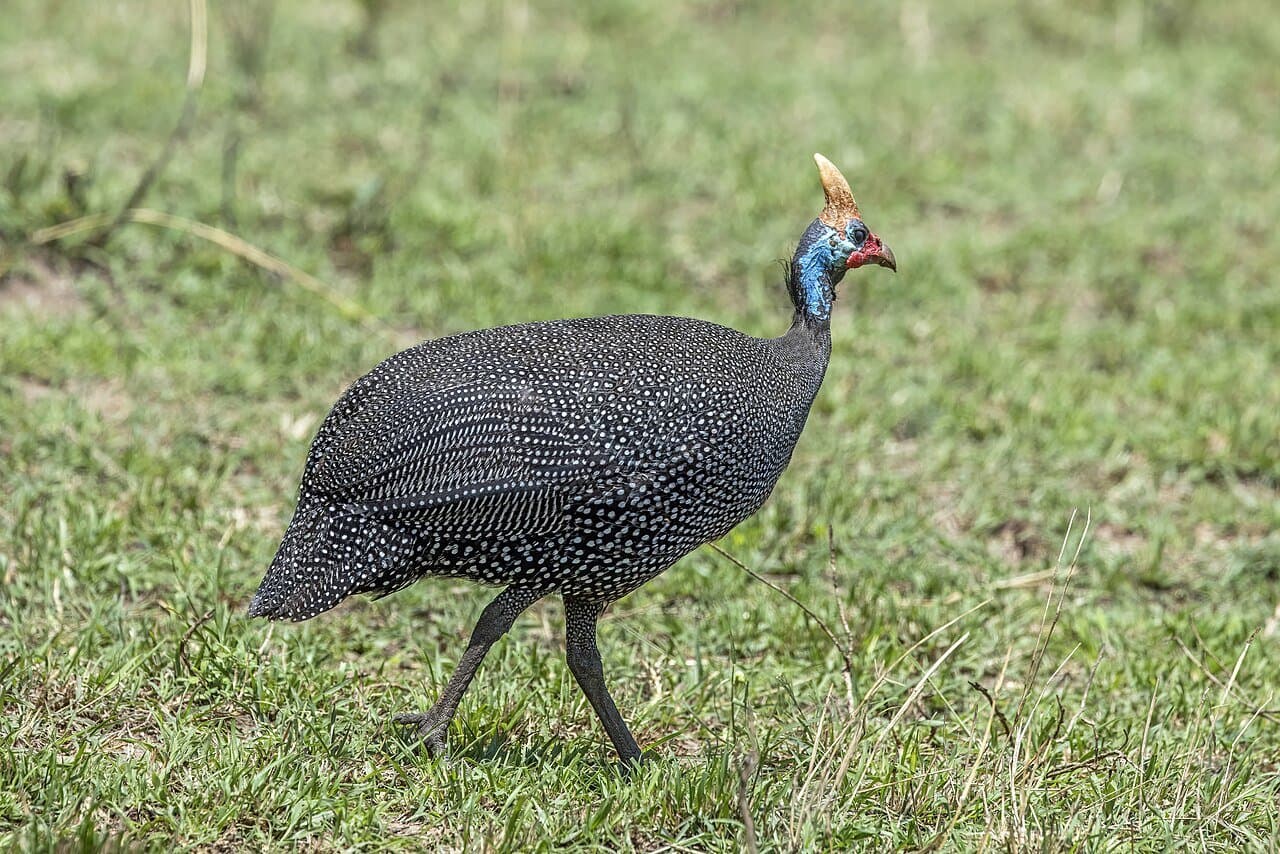
Helmeted guineafowl live across most of sub-Saharan Africa in grasslands, savannas, farmland and scrub. Their dark gray feathers are covered with white speckles, their bare heads are blue, and both males and females have a bony casque, or helmet, on top. They eat snails, beetles, insect larvae, ticks and seeds. Guineafowl usually run from danger, flying only as a last resort, and they roost in trees at night.[1]
Quick facts
- Scientific name
- Numida meleagris[1]
- Weight
- 1.1 to 1.8 kg (2.5 to 4 pounds).[1]
- Lifespan
- 10 to 20 years in the wild.[1]
- Diet
- Omnivore. Snails, beetles, insect larvae, ticks and other invertebrates, plus seeds.[1]
- Habitat
- Grasslands, savannas, farmland and scrubland.[1]
- Where it lives
- Most of sub-Saharan Africa, from Senegal to Eritrea to South Africa.[1]
- Group life
- Flocks from a single pair up to 100 birds. Roosts in trees at night.[1]
- Babies
- 6 to 15 eggs, incubated for up to 30 days. Chicks fledge in about four weeks.[1]
- Conservation status
- Least Concern (IUCN Red List, assessed 2018).[2]
Fun facts
Vocabulary
- casque
- A bony, helmet-like growth on top of a bird's head.
- roost
- To rest or sleep perched up high, such as on a tree branch.
- pecking order
- A ranking in a group that decides who gets food or space first.
- tick
- A tiny eight-legged animal that drinks blood and can spread disease.
- larva
- The young, worm-like stage of an insect (plural: larvae).
See it in person
- Montgomery ZooMontgomery, Alabama · Old World AviarySee this area on the zoo's website ↗
Sources
- [1] Animal Diversity Web, University of Michigan Museum of Zoology. “Numida meleagris (helmeted guineafowl).” https://animaldiversity.org/accounts/Numida_meleagris/ (accessed 2026-10-02)
- [2] IUCN Red List of Threatened Species. “Numida meleagris (Helmeted Guineafowl).” https://www.iucnredlist.org/species/22679555/132052202 (accessed 2026-10-02)
Facts last checked 2026-10-02.