Kori Bustard
Ardeotis kori
One of the world's heaviest flying birds, a ground-walking hunter of African grasslands that puffs up its neck to show off.
Checking teacher reviews…
About the Kori Bustard
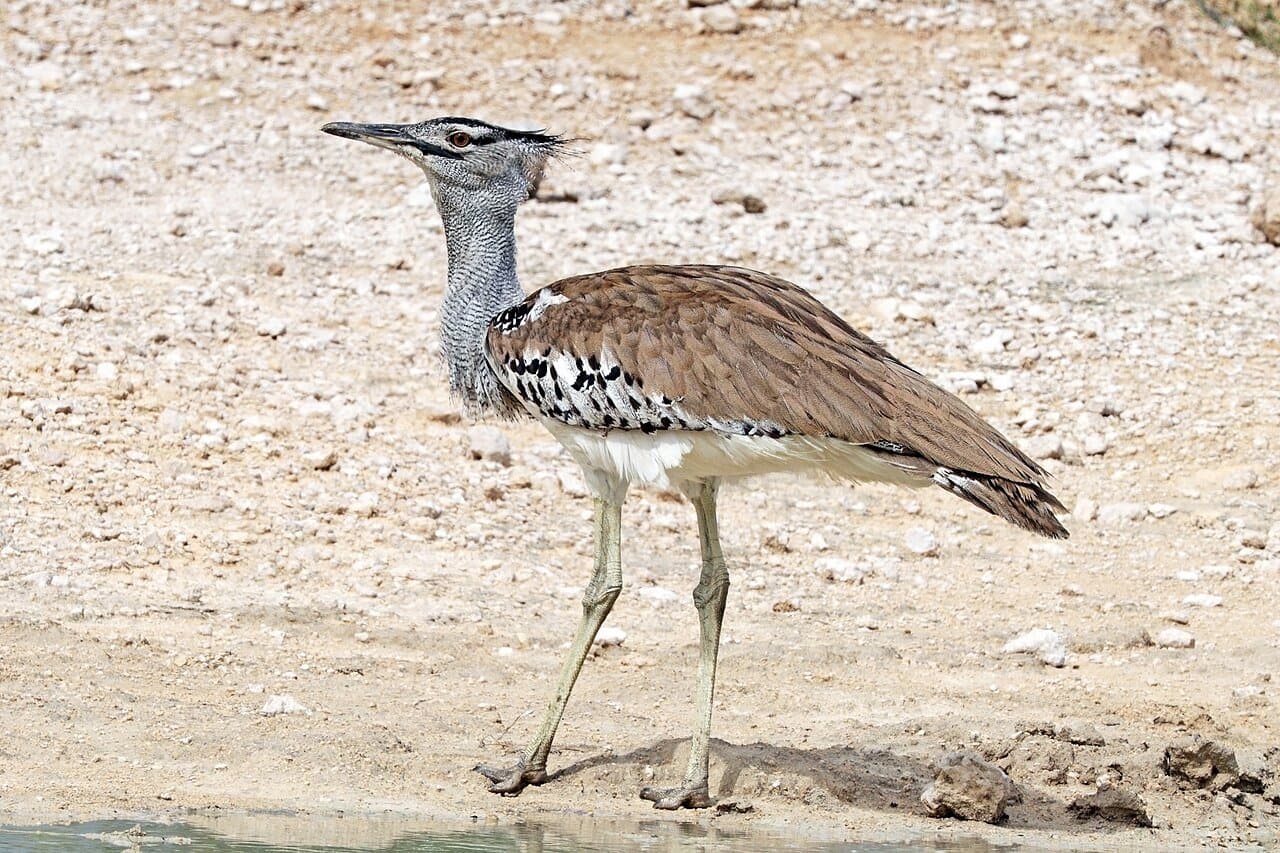
Kori bustards live in open grasslands and lightly wooded savannas of eastern and southern Africa. They stand about 5 feet tall, and males can weigh 24 to 42 pounds, making them the world's heaviest flying birds. They rarely fly unless in serious danger. Kori bustards eat insects, small mammals, lizards, snakes, seeds and berries, and sometimes carrion.[1]
Quick facts
- Scientific name
- Ardeotis kori[1]
- Size
- About 5 feet (1.5 m) tall.[1]
- Weight
- Males 24 to 42 pounds (11 to 19 kg). Females about half that.[1]
- Diet
- Omnivore. Insects, small mammals, lizards, snakes, seeds and berries, sometimes carrion.[1]
- Habitat
- Open grasslands and lightly wooded savanna.[1]
- Where it lives
- Eastern and southern Africa.[1]
- Group life
- Lives mostly on the ground and flies only in serious danger.[1]
- Babies
- One or two eggs, incubated for 23 to 24 days.[1]
- Conservation status
- Near Threatened (IUCN Red List, assessed 2016).[2]
Fun facts
Vocabulary
- esophagus
- The tube that carries food from the mouth to the stomach.
- display
- A show of movements or sounds an animal makes to attract a mate or warn others.
- carrion
- The meat of an animal that is already dead.
- omnivore
- An animal that eats both plants and other animals.
- near threatened
- A conservation label meaning a species may become threatened soon.
See it in person
- Montgomery ZooMontgomery, Alabama · South AmericaSee this area on the zoo's website ↗
- Zoo AtlantaAtlanta, Georgia · All AnimalsSee this animal on the zoo's website ↗
Sources
- [1] Smithsonian's National Zoo & Conservation Biology Institute. “Kori bustard.” https://nationalzoo.si.edu/animals/kori-bustard (accessed 2026-10-02)
- [2] IUCN Red List of Threatened Species. “Ardeotis kori (Kori Bustard).” https://www.iucnredlist.org/species/22691928/93329549 (accessed 2026-10-02)
Facts last checked 2026-10-02.