White-Tailed Deer
Odocoileus virginianus
A common deer of the Americas that flashes its white tail as a warning and bounds away at up to 30 miles per hour.
Checking teacher reviews…
About the White-Tailed Deer
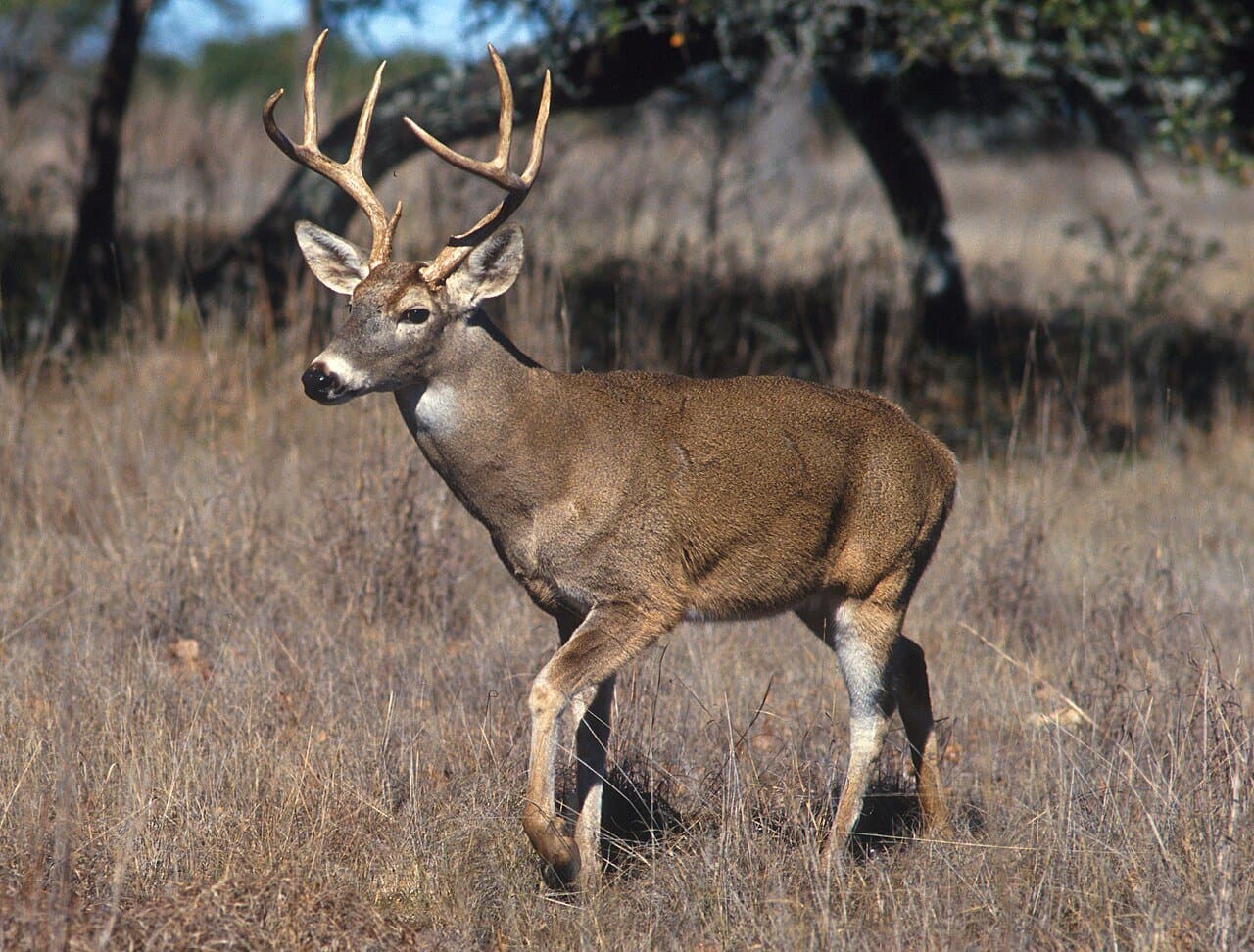
White-tailed deer live from southern Canada through the United States and Central America to Bolivia. They live in forests, swamps and scrublands, especially along edges. Deer eat buds, twigs and leaves, and in deserts they even eat yucca and prickly pear cactus. When startled, a deer waves its white tail side to side as it runs, bounding at up to 30 miles per hour.[1]
Quick facts
- Scientific name
- Odocoileus virginianus[1]
- Size
- 80 to 100 cm (31 to 39 inches) tall at the shoulder.[1]
- Weight
- 57 to 137 kg (125 to 302 pounds).[1]
- Lifespan
- Often only 2 to 3 years in the wild, but up to 20.[1]
- Diet
- Herbivore. Buds, twigs and leaves, and in deserts, plants like yucca and prickly pear cactus.[1]
- Habitat
- Forests, swamps and scrublands, especially thickets and edges.[1]
- Where it lives
- Southern Canada, all of the mainland United States, Central America and parts of South America to Bolivia.[1]
- Group life
- A mother and her fawns are the basic group. Deer are mostly solitary in summer.[1]
- Babies
- Pregnancy lasts about 6.5 months. Fawns weigh 1.5 to 2.5 kg and are spotted with white.[1]
- Conservation status
- Least Concern (IUCN Red List, assessed 2015).[2]
Fun facts
- A frightened white-tailed deer waves its white tail from side to side as it runs.[1]
- White-tailed deer can bound through thick brush at up to 30 miles per hour.[1]
- Deer have scent glands between the two parts of the hoof on all four feet.[1]
- Male deer shed their antlers between January and March and start growing new ones in April or May.[1]
Vocabulary
- fawn
- A baby deer.
- doe / buck
- Names for an adult female (doe) and adult male (buck) deer.
- crepuscular
- Most active at dawn and dusk.
- antler
- A branched bony growth on a deer's head that falls off and regrows every year.
- thicket
- A thick group of bushes or small trees.
See it in person
- Montgomery ZooMontgomery, Alabama · North AmericaSee this area on the zoo's website ↗
Sources
- [1] Animal Diversity Web, University of Michigan Museum of Zoology. “Odocoileus virginianus (white-tailed deer).” https://animaldiversity.org/accounts/Odocoileus_virginianus/ (accessed 2026-10-02)
- [2] IUCN Red List of Threatened Species. “Odocoileus virginianus (White-tailed Deer).” https://www.iucnredlist.org/species/42394/22162580 (accessed 2026-10-02)
Facts last checked 2026-10-02.