
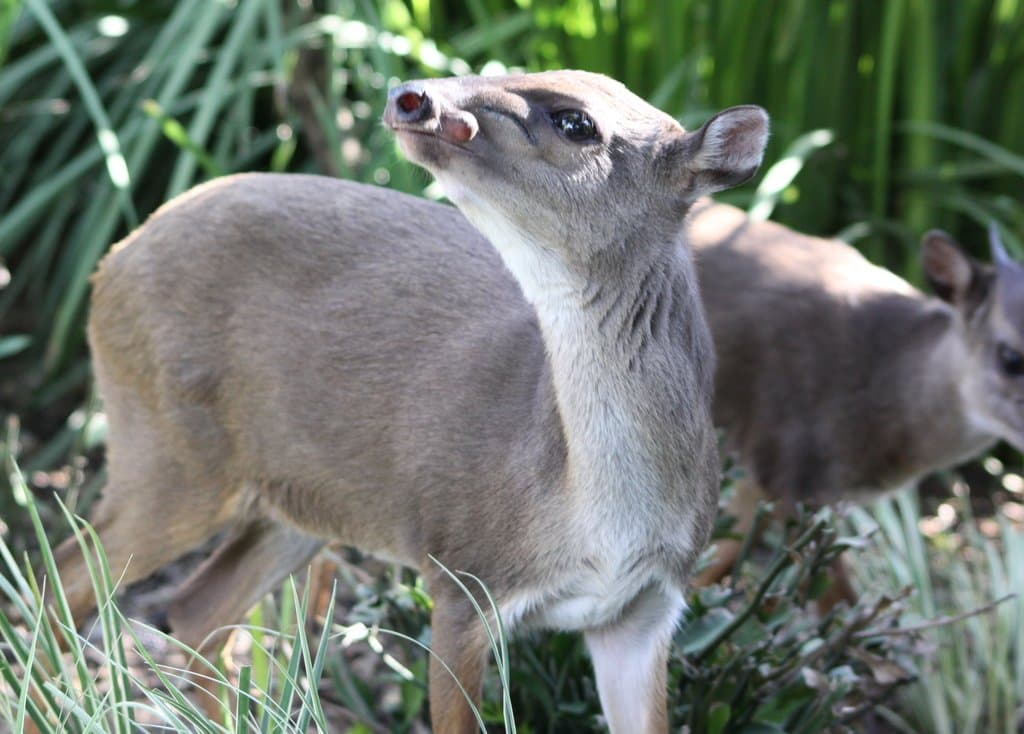
Blue Duiker
Philantomba monticola
A tiny forest antelope of central and southern Africa that weighs only 9 to 13 pounds and lives in pairs.
Checking teacher reviews…
About the Blue Duiker
Blue duikers live in many kinds of African forests, from rainforests to mountain forests, between Nigeria and Gabon in the west and Kenya and South Africa in the east and south. An adult weighs only 4 to 6 kilograms (about 9 to 13 pounds). Blue duikers mostly eat fallen fruit, plus seeds, flowers and fungi. A male and female live together as a pair and defend their own patch of forest.[1]
Quick facts
- Scientific name
- Philantomba monticola[1]
- Size
- 55 to 72 cm (about 22 to 28 inches) long, plus a 7 to 12.5 cm tail.[1]
- Weight
- 4 to 6 kg (about 9 to 13 pounds).[1]
- Lifespan
- 10 to 15 years in captivity. About 12 years at most in the wild.[1]
- Diet
- Mostly fallen fruit, plus seeds, flowers and fungi.[1]
- Habitat
- Rainforests, riverside forests, dense thickets and mountain forests.[1]
- Where it lives
- Central and southern Africa, from Nigeria to Gabon and from Kenya to South Africa.[1]
- Group life
- Lives in pairs that defend a territory.[1]
- Babies
- Pregnancy lasts 196 to 216 days (about 7 months). Usually one calf, weaned at 2.5 to 3 months.[1]
- Conservation status
- Least Concern (IUCN Red List, assessed 2016).[2]
Fun facts
Vocabulary
- antelope
- A fast, deer-like mammal with hooves and horns, found mostly in Africa and Asia.
- territory
- An area an animal lives in and defends from others.
- diurnal
- Active during the day and resting at night.
- fungi
- Living things such as mushrooms and molds that are not plants or animals.
- wean
- When a young animal stops drinking its mother's milk and starts eating other food.
See it in person
- Montgomery ZooMontgomery, Alabama · AfricaSee this area on the zoo's website ↗
- Montgomery ZooMontgomery, Alabama · Old World AviarySee this area on the zoo's website ↗
- San Francisco Zoo & GardensSan Francisco, California · MammalsSee this animal on the zoo's website ↗
These zoos had this animal when we gathered our information, but animals sometimes move. Check the zoo's website or contact the zoo before you visit.
Sources
- [1] Animal Diversity Web, University of Michigan Museum of Zoology. “Philantomba monticola (blue duiker).” https://animaldiversity.org/accounts/Philantomba_monticola/ (accessed 2026-10-02)
- [2] IUCN Red List of Threatened Species. “Philantomba monticola (Blue Duiker).” https://www.iucnredlist.org/species/4143/50183103 (accessed 2026-10-02)
Facts last checked 2026-10-02.


