
Bongo
Tragelaphus eurycerus
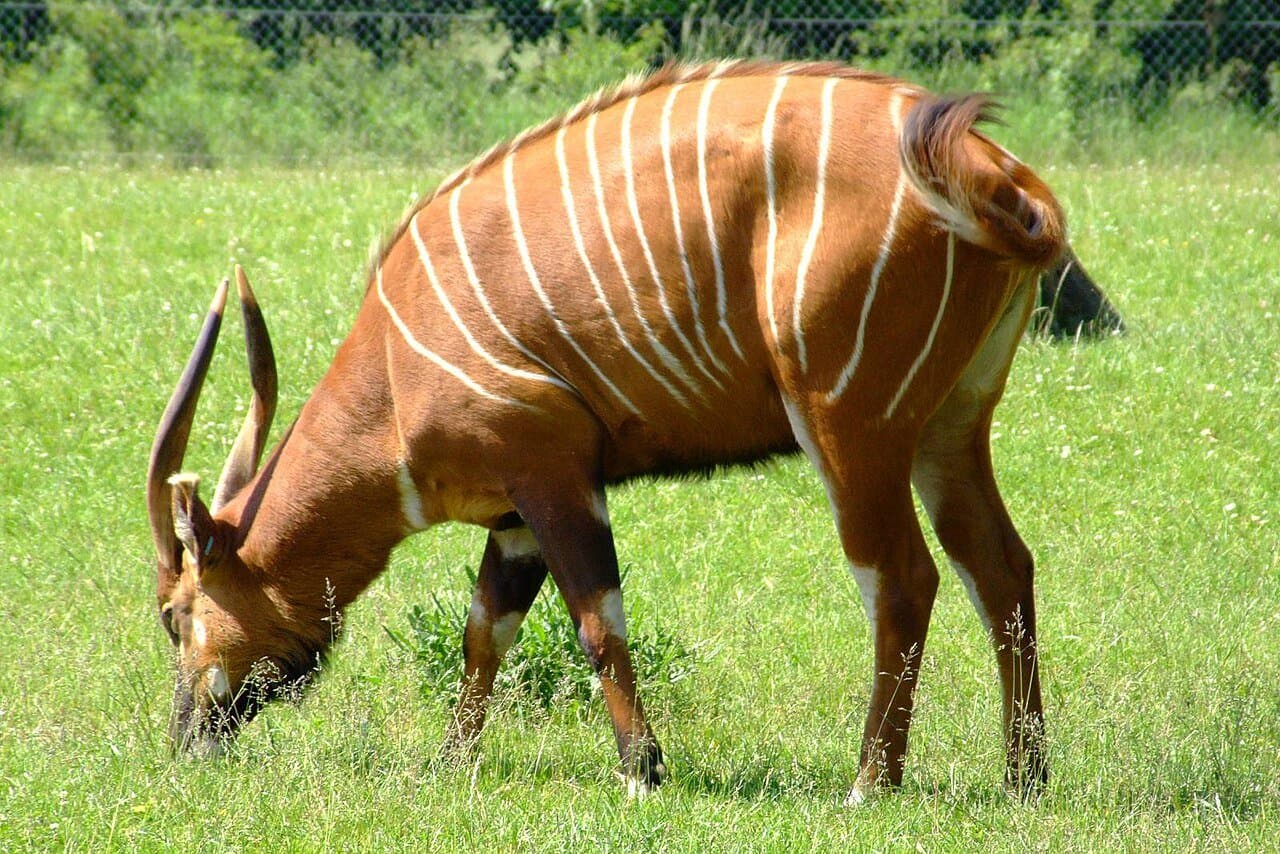
A large forest antelope of tropical Africa with 10 to 15 pale stripes down each side and horns up to 3 feet long.
Checking teacher reviews…
About the Bongo
Bongos live in rainforests and dense forests across West and Central Africa, from the lowland rainforests of West Africa to the Congo Basin, the Central African Republic and southern Sudan. A bongo has 10 to 15 whitish-yellow stripes running down each side. Bongos are browsers that eat leaves, bushes, vines, bark, grasses, roots, flowers and fruit. Their horns can grow up to 3 feet long.[1]
Quick facts
- Scientific name
- Tragelaphus eurycerus[1]
- Size
- About 4 feet (1.2 m) tall at the shoulder.[1]
- Weight
- 500 to 900 pounds (225 to 410 kg).[1]
- Lifespan
- Up to 21 years in captivity. No data for the wild.[1]
- Diet
- Herbivore. Browses on leaves, bushes, vines, bark, grasses, roots, cereals, shrubs, flowers and fruits.[1]
- Habitat
- Rainforests, dense forests and forest-savannas.[1]
- Where it lives
- Lowland rainforests of West Africa and the Congo Basin to the Central African Republic and southern Sudan.[1]
- Babies
- Pregnancy lasts about 9 months.[1]
- Conservation status
- Near Threatened (IUCN Red List, assessed 2016).[2]
Fun facts
Vocabulary
- antelope
- A fast, deer-like mammal with hooves and horns, found mostly in Africa and Asia.
- browser
- An animal that eats leaves, twigs and shoots from bushes and trees.
- rainforest
- A thick forest that gets a lot of rain all year.
- near threatened
- A conservation label meaning a species may become threatened soon.
- generation
- The average time between an animal's birth and the birth of its own young.
See it in person
- Montgomery ZooMontgomery, Alabama · AfricaSee this area on the zoo's website ↗
- Montgomery ZooMontgomery, Alabama · Africa ForestSee this area on the zoo's website ↗
- San Francisco Zoo & GardensSan Francisco, California · MammalsSee this animal on the zoo's website ↗
- Omaha's Henry Doorly Zoo and AquariumOmaha, Nebraska · Scott African GrasslandsSee this area on the zoo's website ↗
These zoos had this animal when we gathered our information, but animals sometimes move. Check the zoo's website or contact the zoo before you visit.
Sources
- [1] African Wildlife Foundation. “Bongo.” https://www.awf.org/wildlife-conservation/bongo (accessed 2026-10-02)
- [2] IUCN Red List of Threatened Species. “Tragelaphus eurycerus (Bongo).” https://www.iucnredlist.org/species/22047/50195617 (accessed 2026-10-02)
Facts last checked 2026-10-02.


