
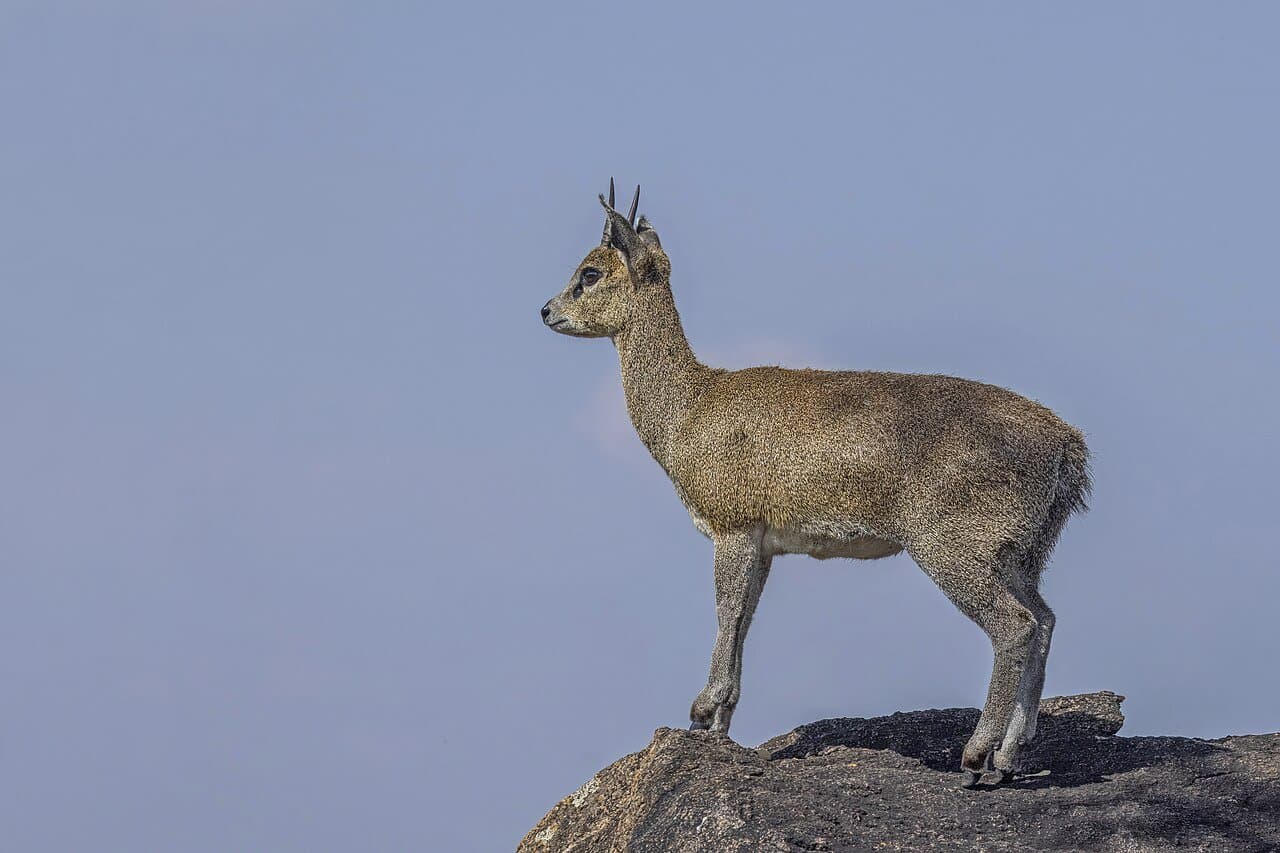
Klipspringer
Oreotragus oreotragus
A small, sure-footed African antelope that hops from rock to rock on tiny hooves the size of a dime.
Checking teacher reviews…
About the Klipspringer
Klipspringers stand about 2 feet tall at the shoulder and weigh 22 to 40 pounds. Their stiff, hollow hairs give them a grizzled look and protect them from heat. Each hoof is about the size of a dime and works a little like a suction cup, so a klipspringer can jump onto a landing spot the size of a silver dollar. They live among rocky hills called kopjes and eat leaves, blossoms, fruit and lichen.[1]
Quick facts
- Scientific name
- Oreotragus oreotragus[1]
- Size
- About 2 feet tall at the shoulder.[1]
- Weight
- 22 to 40 pounds.[1]
- Diet
- Herbivore. Leaves, blossoms, fruit and lichen.[1]
- Habitat
- Rocky hills, kopjes, riverbeds and mountains up to 13,000 feet.[1]
- Where it lives
- Africa.[1]
- Group life
- Monogamous pairs or small family groups.[1]
- Conservation status
- Least Concern (IUCN Red List, assessed 2016).[2]
Fun facts
Vocabulary
- kopje
- A rocky hill that rises out of the flat African grassland (say "KOP-ee").
- antelope
- A fast, hoofed, horned animal related to cattle and goats.
- sentinel
- An animal that keeps watch for danger while others eat or rest.
- browse
- Leaves and twigs that animals eat from bushes and trees.
- least concern
- A conservation label meaning a species is widespread and not at risk of dying out soon.
See it in person
- Omaha's Henry Doorly Zoo and AquariumOmaha, Nebraska · Scott African GrasslandsSee this area on the zoo's website ↗
- Oakland ZooOakland, California · African SavannaSee this animal on the zoo's website ↗
These zoos had this animal when we gathered our information, but animals sometimes move. Check the zoo's website or contact the zoo before you visit.
Sources
- [1] San Diego Zoo Wildlife Alliance. “Klipspringer.” https://animals.sandiegozoo.org/animals/klipspringer (accessed 2026-10-02)
- [2] IUCN Red List of Threatened Species. “Oreotragus oreotragus (Klipspringer).” https://www.iucnredlist.org/species/15485/50191264 (accessed 2026-10-02)
Facts last checked 2026-10-02.


