
Cattle Egret
Bubulcus ibis
A small white heron that follows grazing animals to catch the insects they stir up, and has spread from Africa around the world.
Checking teacher reviews…
About the Cattle Egret
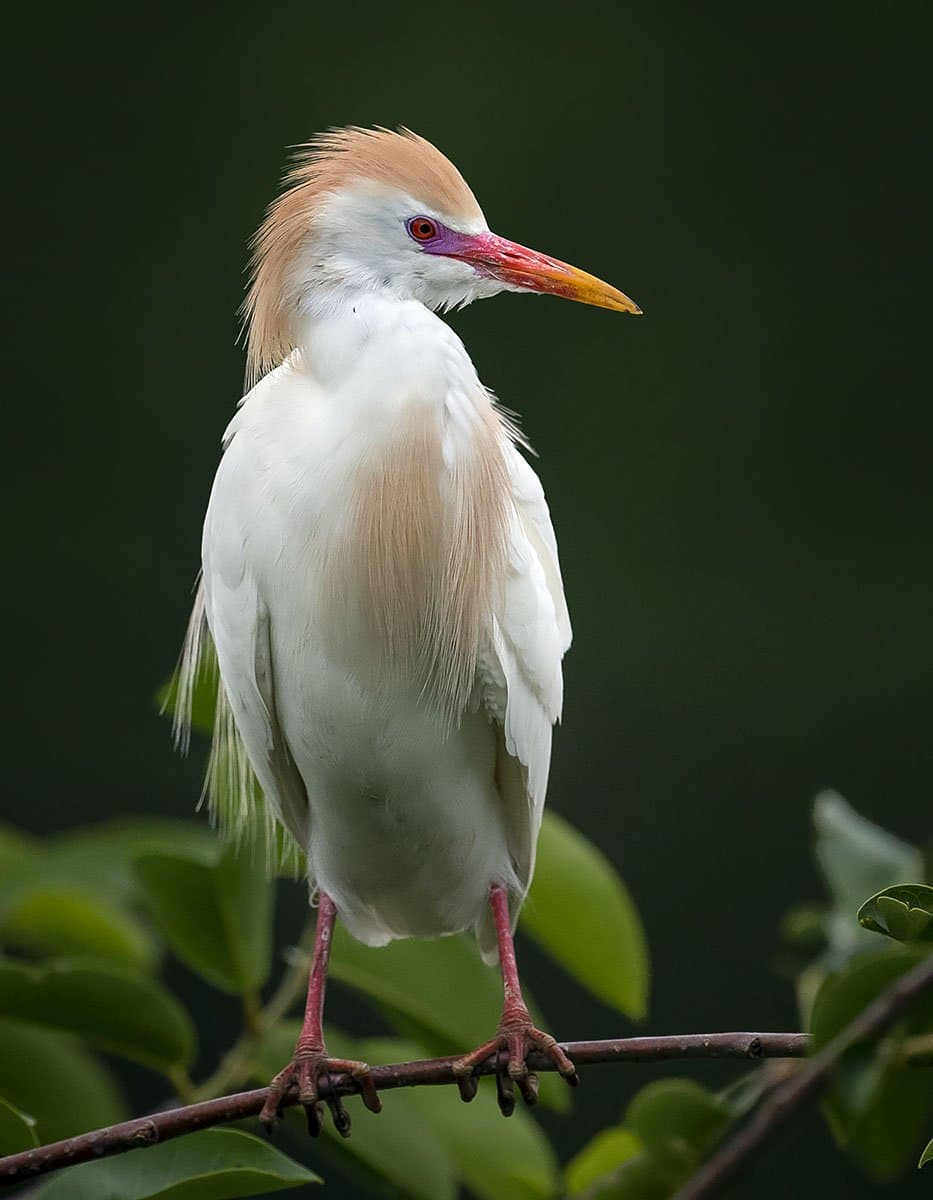
Cattle egrets follow grazing animals like cattle and catch the grasshoppers, crickets, flies and other small animals they disturb. By staying near cattle, an egret can get up to 50 percent more food while using only two-thirds as much energy. In breeding season, cattle egrets grow buff-colored feathers on the head, neck and back, and their eyes, legs and bill turn red.[1]
Quick facts
- Scientific name
- Bubulcus ibis[1]
- Size
- 46 to 56 cm (18 to 22 inches) long, with a wingspan of 88 to 96 cm.[1]
- Weight
- About 220 g (8 ounces).[1]
- Lifespan
- Up to 23 years in the wild.[1]
- Diet
- Insects such as grasshoppers, crickets and flies, plus spiders, frogs and moths.[1]
- Habitat
- Pastures and fields, often away from water.[1]
- Where it lives
- Originally Africa and southern Spain. Now also North and South America, Europe, Asia and Australia.[1]
- Group life
- Nests in large colonies with other wading birds.[1]
- Babies
- Usually 3 or 4 eggs, incubated for about 24 days.[1]
- Conservation status
- Least Concern (IUCN Red List, assessed 2016).[2]
Fun facts
Vocabulary
- egret
- A kind of heron, usually with white feathers.
- heron
- A long-legged, long-necked bird that usually hunts in water.
- pasture
- A grassy field where farm animals graze.
- breeding plumage
- Special feathers some birds grow during mating season.
- colony
- A large group of animals of one kind that live or nest close together.
See it in person
- Montgomery ZooMontgomery, Alabama · Flight AviarySee this area on the zoo's website ↗
- Omaha's Henry Doorly Zoo and AquariumOmaha, Nebraska · Hubbard Gorilla ValleySee this area on the zoo's website ↗
- Omaha's Henry Doorly Zoo and AquariumOmaha, Nebraska · Simmons Aviary and LagoonSee this area on the zoo's website ↗
These zoos had this animal when we gathered our information, but animals sometimes move. Check the zoo's website or contact the zoo before you visit.
Sources
- [1] Animal Diversity Web, University of Michigan Museum of Zoology. “Bubulcus ibis (cattle egret).” https://animaldiversity.org/accounts/Bubulcus_ibis/ (accessed 2026-10-02)
- [2] IUCN Red List of Threatened Species. “Bubulcus ibis (Cattle Egret).” https://www.iucnredlist.org/species/22697109/155477521 (accessed 2026-10-02)
Facts last checked 2026-10-02.
More Wading Birds
 African Sacred IbisThreskiornis aethiopicus
 African SpoonbillPlatalea alba
 American FlamingoPhoenicopterus ruber
 Black Crowned CraneBalearica pavonina
 Blue CraneAnthropoides paradiseus
 Chilean FlamingoPhoenicopterus chilensis
 Grey Crowned CraneBalearica regulorum (East African crowned crane: B. r. gibbericeps)
 Hadada IbisBostrychia hagedash
 HamerkopScopus umbretta
 Lesser FlamingoPhoeniconaias minor
 Madagascar Crested IbisLophotibis cristata
 Malagasy Sacred IbisThreskiornis bernieri
 Marabou StorkLeptoptilos crumenifer
 Northern Bald IbisGeronticus eremita
 Roseate SpoonbillPlatalea ajaja
 Scarlet IbisEudocimus ruber
 Snowy EgretEgretta thula
 Straw-Necked IbisThreskiornis spinicollis
 Wattled CraneBugeranus carunculatus
 White StorkCiconia ciconia
 White-Naped CraneGrus vipio (also called Antigone vipio)
 Yellow-Billed StorkMycteria ibis