
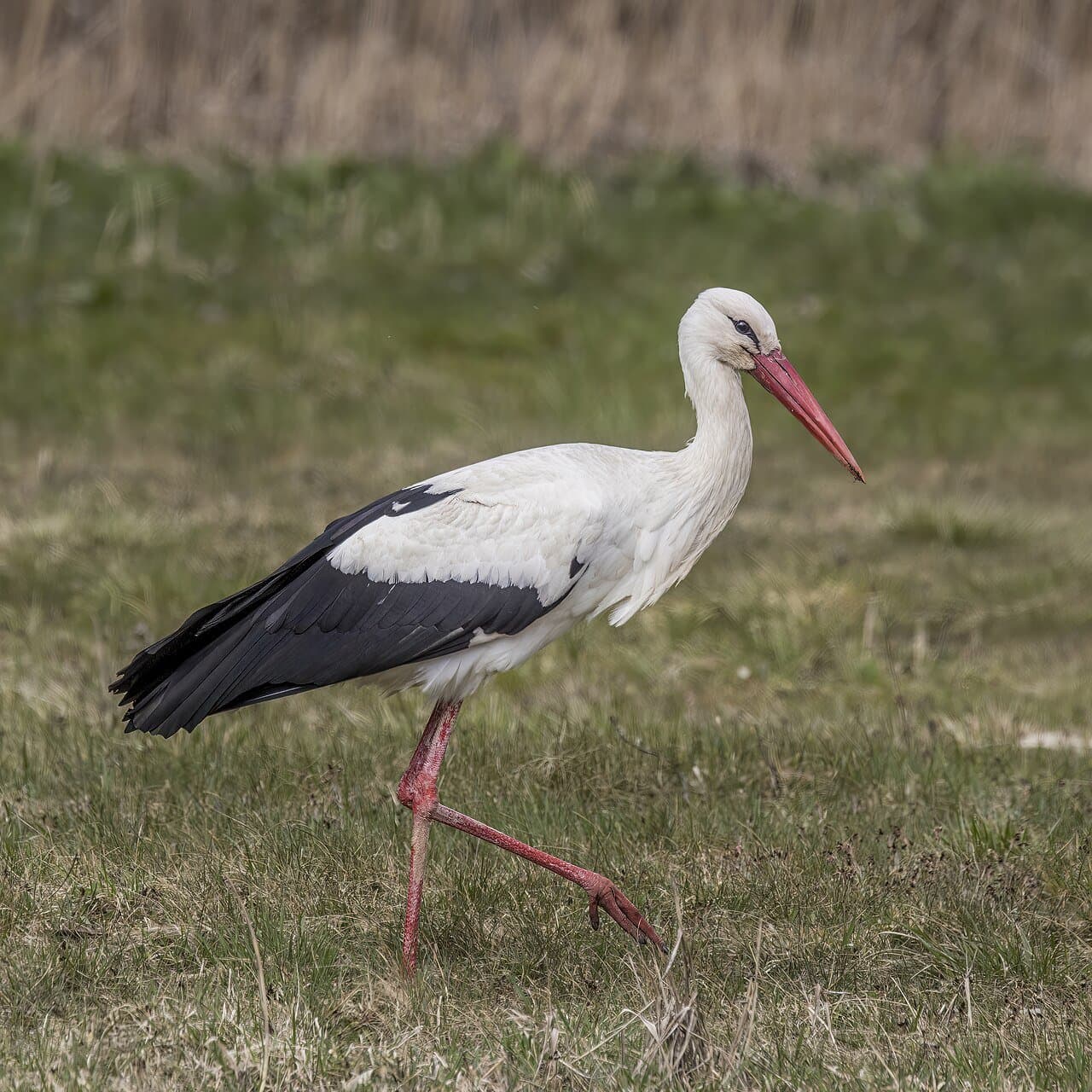
White Stork
Ciconia ciconia
A big white-and-black bird with a red bill that breeds in Europe, winters in Africa and inspired the story of storks delivering babies.
Checking teacher reviews…
About the White Stork
White storks breed in Europe and southwestern Asia in spring and summer. In August or September they migrate in large flocks to Africa, riding warm rising air. They hunt in grasslands, marshes and floodplains, eating mice, voles, large insects, frogs, snakes, lizards, fish and more. Their long red legs help keep them warm while wading.[1]
Quick facts
- Scientific name
- Ciconia ciconia[1]
- Diet
- Carnivore. Small mammals, large insects, frogs, snakes, lizards, fish and more.[1]
- Habitat
- Grasslands, shallow marshes, lagoons and floodplains.[1]
- Where it lives
- Breeds in Europe and southwestern Asia; winters in Africa.[1]
- Group life
- Migrates in large flocks. Pairs often mate for life.[1]
- Babies
- Three to five eggs, incubated about a month. Chicks fly about two months after hatching.[1]
- Conservation status
- Least Concern (IUCN Red List, assessed 2016).[2]
Fun facts
Vocabulary
- migrate
- To travel from one region to another as the seasons change.
- thermal
- A rising column of warm air that birds use to gain height.
- myth
- A traditional story that is not literally true.
- carnivore
- An animal that eats mostly meat.
- wade
- To walk through shallow water.
See it in person
- Zoo AtlantaAtlanta, Georgia · All AnimalsSee this animal on the zoo's website ↗
- Omaha's Henry Doorly Zoo and AquariumOmaha, Nebraska · Hubbard Gorilla ValleySee this area on the zoo's website ↗
- Omaha's Henry Doorly Zoo and AquariumOmaha, Nebraska · Simmons Aviary and LagoonSee this area on the zoo's website ↗
These zoos had this animal when we gathered our information, but animals sometimes move. Check the zoo's website or contact the zoo before you visit.
Sources
- [1] Zoo Atlanta. “White Stork.” https://zooatlanta.org/animal/white-stork/ (accessed 2026-10-02)
- [2] IUCN Red List of Threatened Species. “Ciconia ciconia (White Stork).” https://www.iucnredlist.org/species/22697691/86248677 (accessed 2026-10-02)
Facts last checked 2026-10-02.
More Wading Birds
 African Sacred IbisThreskiornis aethiopicus
 African SpoonbillPlatalea alba
 American FlamingoPhoenicopterus ruber
 Black Crowned CraneBalearica pavonina
 Blue CraneAnthropoides paradiseus
 Cattle EgretBubulcus ibis
 Chilean FlamingoPhoenicopterus chilensis
 Grey Crowned CraneBalearica regulorum (East African crowned crane: B. r. gibbericeps)
 Hadada IbisBostrychia hagedash
 HamerkopScopus umbretta
 Lesser FlamingoPhoeniconaias minor
 Madagascar Crested IbisLophotibis cristata
 Malagasy Sacred IbisThreskiornis bernieri
 Marabou StorkLeptoptilos crumenifer
 Northern Bald IbisGeronticus eremita
 Roseate SpoonbillPlatalea ajaja
 Scarlet IbisEudocimus ruber
 Snowy EgretEgretta thula
 Straw-Necked IbisThreskiornis spinicollis
 Wattled CraneBugeranus carunculatus
 White-Naped CraneGrus vipio (also called Antigone vipio)
 Yellow-Billed StorkMycteria ibis