
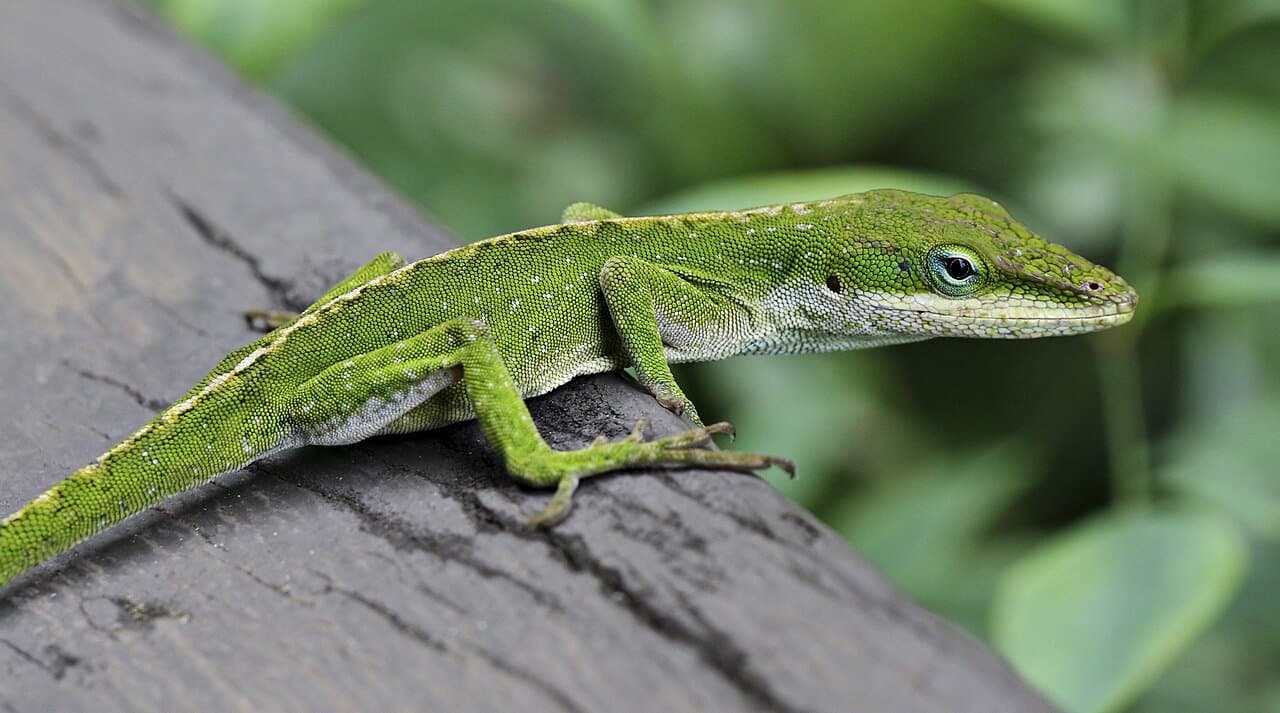
Green Anole
Anolis carolinensis
A small lizard of the southeastern U.S. that can change color from bright green to brown.
Checking teacher reviews…
About the Green Anole
Green anoles live across the southeastern United States, from North Carolina to Texas and Florida, in grasslands, forests, wetlands and even cities. They weigh just 2 to 6 grams, and their tails are more than half their length. Special color cells let them change from bright green to yellow-green to dark brown, depending on mood and surroundings.[1][2]
Quick facts
Fun facts
Vocabulary
- chromatophore
- A skin cell with color that lets an animal change color.
- insectivore
- An animal that eats mostly insects.
- territory
- An area an animal lives in and defends.
- diurnal
- Active mainly during the day.
- least concern
- A conservation label meaning a species is widespread and not at risk of dying out soon.
See it in person
- Oakland ZooOakland, California · Reptile and Amphibian Discovery RoomSee this animal on the zoo's website ↗
These zoos had this animal when we gathered our information, but animals sometimes move. Check the zoo's website or contact the zoo before you visit.
Sources
- [1] Oakland Zoo. “Green Anole.” https://www.oaklandzoo.org/animals/green-anole/ (accessed 2026-10-02)
- [2] Animal Diversity Web, University of Michigan. “Green anole (Anolis carolinensis).” https://animaldiversity.org/accounts/Anolis_carolinensis/ (accessed 2026-10-02)
- [3] IUCN Red List of Threatened Species. “Anolis carolinensis (Green Anole).” https://www.iucnredlist.org/species/64188/18972474 (accessed 2026-10-02)
Facts last checked 2026-10-02.
More Lizards
 Black Tree MonitorVaranus beccarii
 Blue Spiny LizardSceloporus cyanogenys
 Caiman LizardDracaena guianensis
 Common Blue-Tongued SkinkTiliqua scincoides
 Common ChuckwallaSauromalus ater
 Gila MonsterHeloderma suspectum
 Green Spiny LizardSceloporus malachiticus
 Guatemalan Beaded LizardHeloderma charlesbogerti
 Henkel's Leaf-Tailed GeckoUroplatus henkeli
 Komodo DragonVaranus komodoensis
 Motagua Spiny-Tailed IguanaCtenosaura palearis
 Ornate UromastyxUromastyx ornata
 Rhinoceros IguanaCyclura cornuta
 Solomon Islands SkinkCorucia zebrata
 Sudan Plated LizardGerrhosaurus major (also called Broadleysaurus major)
 White-Throated MonitorVaranus albigularis