
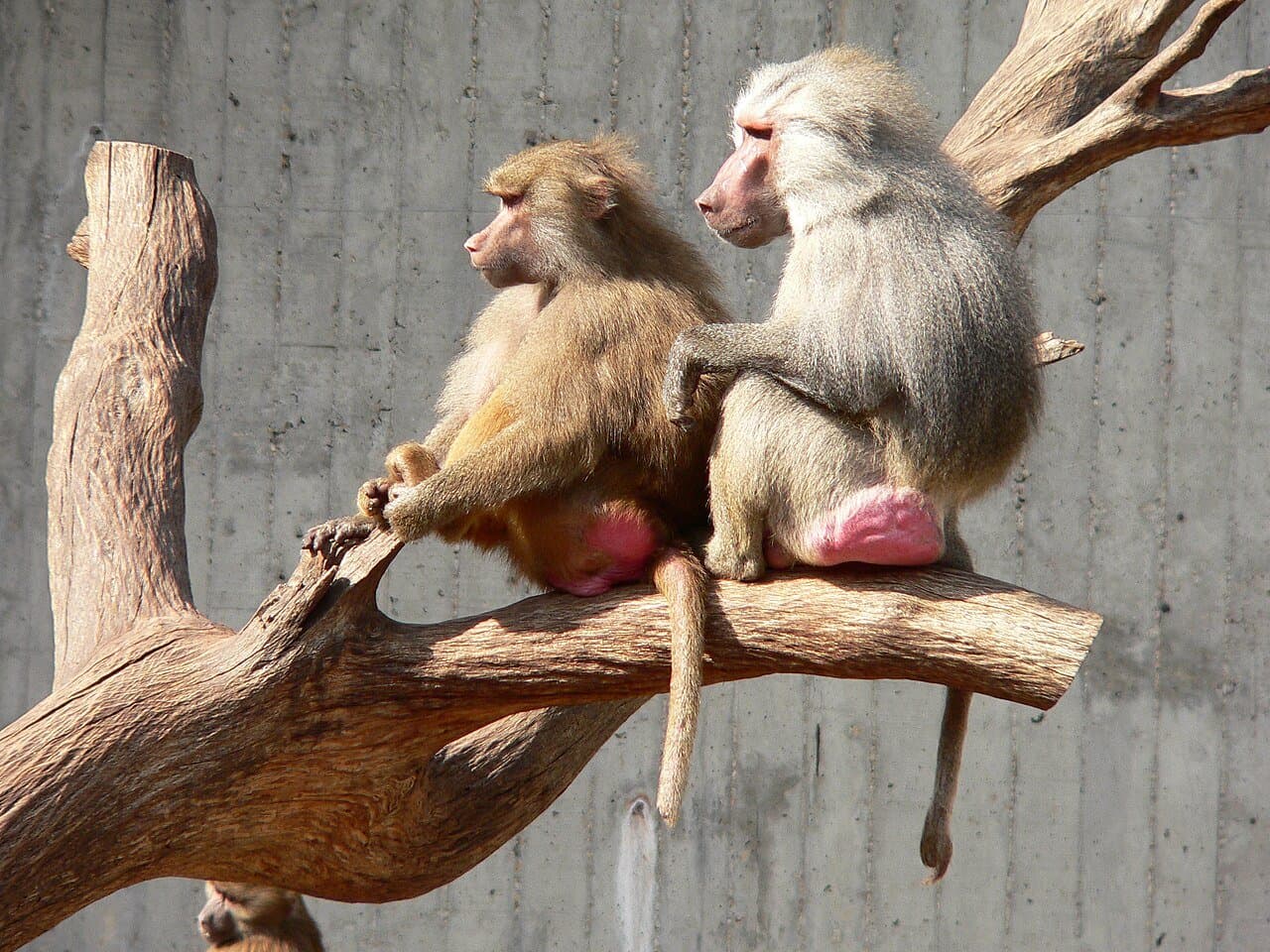
Hamadryas Baboon
Papio hamadryas
A baboon of the Horn of Africa whose males have bushy silver manes and lead small family units within big troops.
Checking teacher reviews…
About the Hamadryas Baboon
Hamadryas baboons live in Ethiopia, Somalia and Eritrea, in semi-deserts, steppes, mountain meadows and short-grass savannas, where they need water holes and cliffs for sleeping. Males stand 24 to 30 inches tall and weigh about 50 pounds, with bushy silvery manes; females are about 20 pounds and olive-brown. They eat mostly fruit, plus grasses, insects, seeds and flowers.[1]
Quick facts
- Scientific name
- Papio hamadryas[1]
- Size
- Males 24 to 30 inches tall; females 20 to 25 inches.[1]
- Weight
- Males about 50 pounds; females about 20 pounds.[1]
- Lifespan
- 30 to 40 years in the wild.[1]
- Diet
- Omnivore. Mostly fruit, plus grasses, insects, seeds and flowers.[1]
- Habitat
- Semi-deserts, steppes, alpine meadows and short-grass savannas with cliffs and water.[1]
- Where it lives
- Ethiopia, Somalia and Eritrea; also Yemen and Saudi Arabia.[1]
- Group life
- One-male units within larger troops. Active during the day.[1]
- Babies
- One baby, born with black fur.[1]
- Conservation status
- Least Concern (IUCN Red List, assessed 2016).[2]
Fun facts
Vocabulary
- troop
- A group of monkeys that live together.
- mane
- Long hair growing on an animal's neck and shoulders.
- sexually dimorphic
- Having males and females that look different.
- steppe
- A large, dry, treeless grassland.
- least concern
- A conservation label meaning a species is widespread and not at risk of dying out soon.
See it in person
- Oakland ZooOakland, California · African SavannaSee this animal on the zoo's website ↗
These zoos had this animal when we gathered our information, but animals sometimes move. Check the zoo's website or contact the zoo before you visit.
Sources
- [1] Oakland Zoo. “Hamadryas Baboon.” https://www.oaklandzoo.org/animals/hamadryas-baboon/ (accessed 2026-10-02)
- [2] IUCN Red List of Threatened Species. “Papio hamadryas (Hamadryas Baboon).” https://www.iucnredlist.org/species/16019/17953082 (accessed 2026-10-02)
Facts last checked 2026-10-02.
More Monkeys
 Angolan Colobus MonkeyColobus angolensis
 Common MarmosetCallithrix jacchus
 Cotton-Top TamarinSaguinus oedipus (also called Oedipomidas oedipus)
 DrillMandrillus leucophaeus
 François' LangurTrachypithecus francoisi
 Golden Lion TamarinLeontopithecus rosalia
 MandrillMandrillus sphinx
 Schmidt's GuenonCercopithecus ascanius schmidti
 Squirrel MonkeySaimiri species
 Wolf's GuenonCercopithecus wolfi