Southern Cassowary
Casuarius casuarius
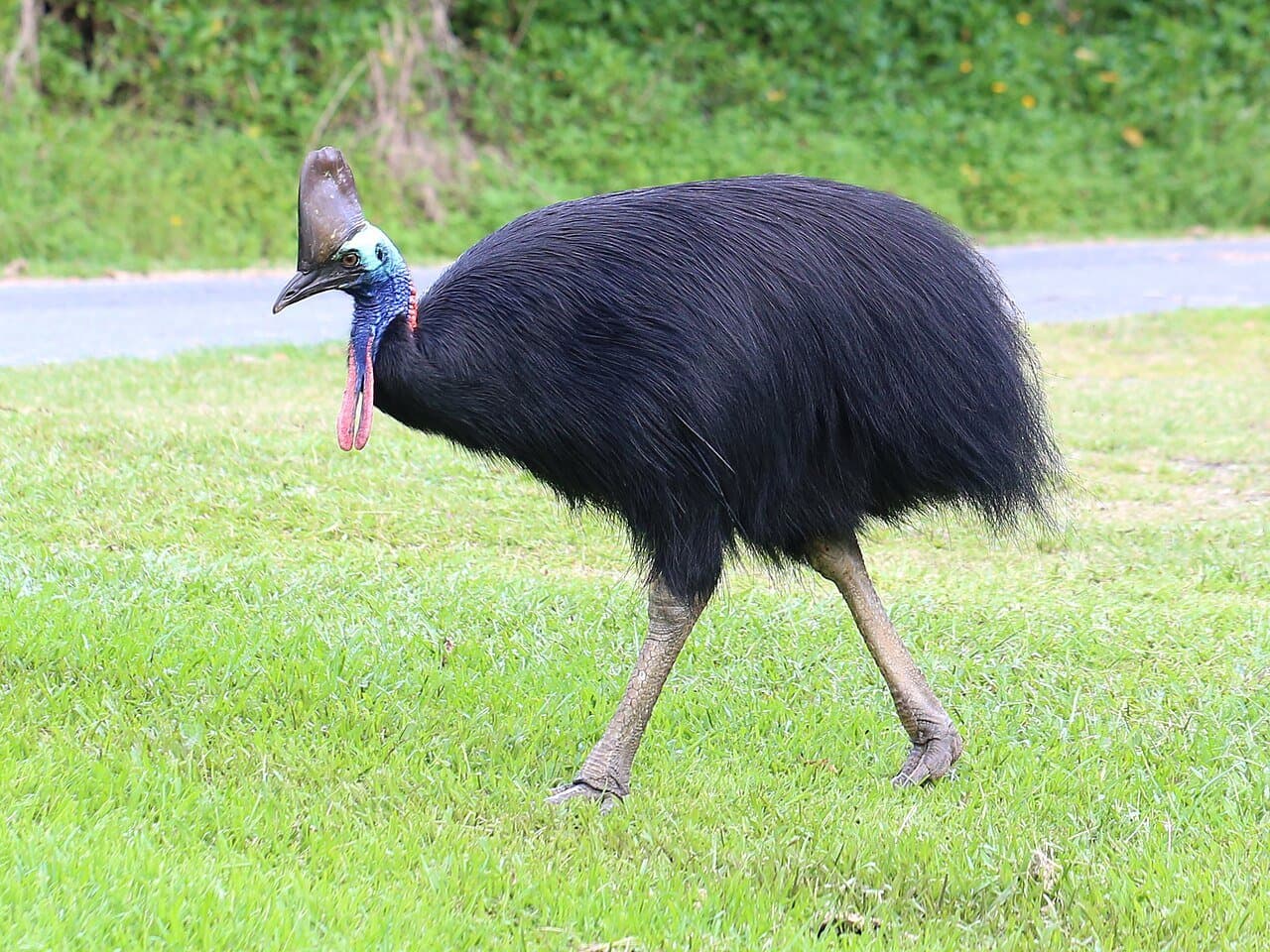
A huge flightless rainforest bird of New Guinea and Australia with a bony helmet, a blue-and-red neck and a dagger-like claw.
Checking teacher reviews…
About the Southern Cassowary
Southern cassowaries, also called double-wattled cassowaries, can stand 6 feet tall and weigh 100 to 150 pounds. They live in the rainforests and savanna woodlands of New Guinea and northeastern Australia. Coarse black feathers protect them from thorns, and they can run up to 30 miles per hour through thick brush. They eat fruit, insects, eggs, frogs, fungi and carrion. They are also strong swimmers.[1]
Quick facts
- Scientific name
- Casuarius casuarius[1]
- Size
- Up to 6 feet tall.[1]
- Weight
- 100 to 150 pounds. Females are larger.[1]
- Lifespan
- 12 to 19 years in the wild. Around 40 in human care.[1]
- Diet
- Fruit, insects, eggs, frogs, fungi and carrion.[1]
- Habitat
- Rainforest and savanna woodland.[1]
- Where it lives
- New Guinea and northeastern Australia.[1]
- Group life
- Solitary and territorial except during breeding.[1]
- Babies
- 3 to 5 green eggs, incubated about 60 days by the male.[1]
- Conservation status
- Least Concern (IUCN Red List, assessed 2018).[2]
Fun facts
Vocabulary
- casque
- A hard, helmet-like crest on a bird's head.
- wattle
- A flap of colorful skin hanging from a bird's head or neck.
- ratite
- A large flightless bird with a flat breastbone, such as an ostrich, emu or cassowary.
- carrion
- The meat of an animal that is already dead.
- incubate
- To keep eggs warm until they hatch.
See it in person
- San Francisco Zoo & GardensSan Francisco, California · BirdsSee this animal on the zoo's website ↗
Sources
- [1] San Francisco Zoo & Gardens. “Double-wattled Cassowary.” https://www.sfzoo.org/double-wattled-cassowary/ (accessed 2026-10-02)
- [2] IUCN Red List of Threatened Species. “Casuarius casuarius (Southern Cassowary).” https://www.iucnredlist.org/species/22678108/131902050 (accessed 2026-10-02)
Facts last checked 2026-10-02.