
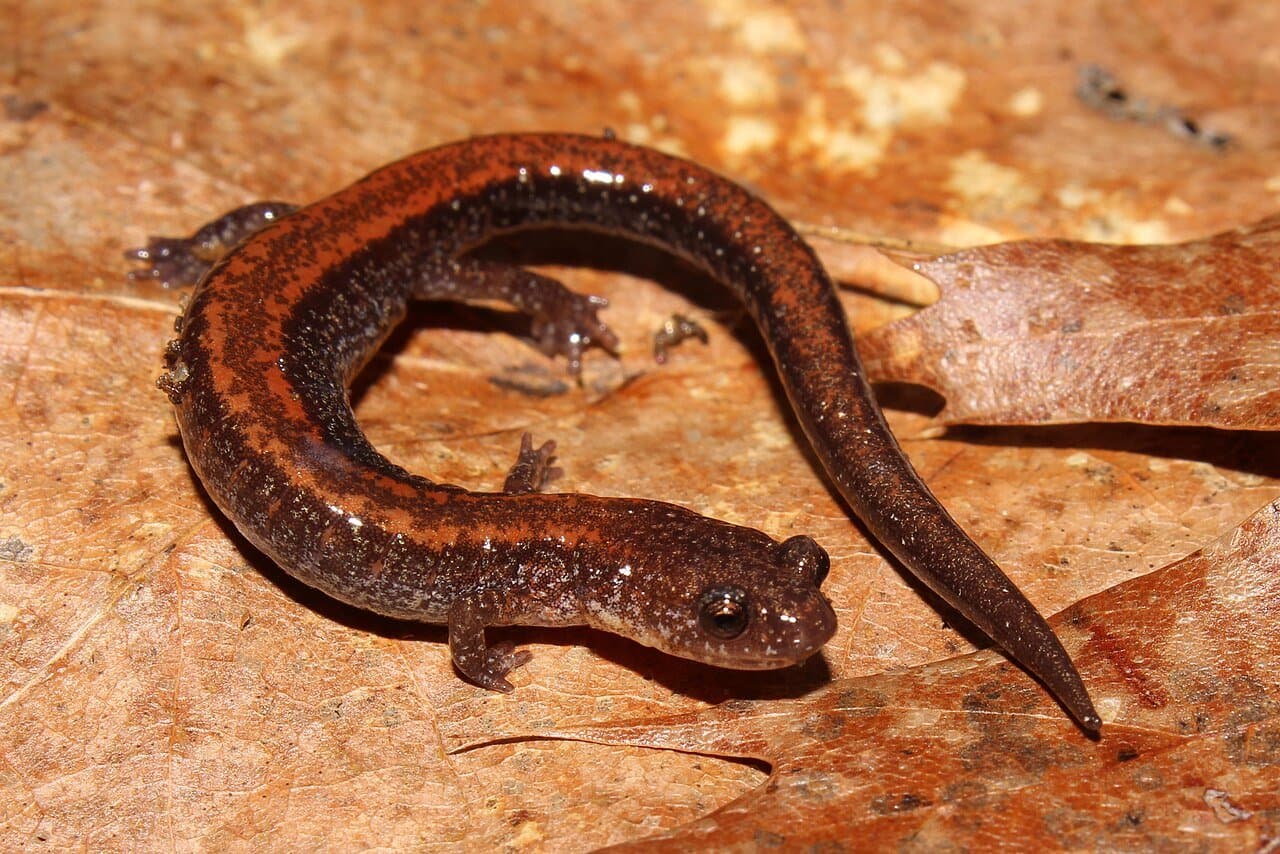
Eastern Red-backed Salamander
Plethodon cinereus
A small, lungless woodland salamander that breathes through its skin and can drop its tail to escape.
Checking teacher reviews…
About the Eastern Red-backed Salamander
Eastern red-backed salamanders are 2 to 5 inches long. Some have an orange to red stripe down the back, and others, called lead-backs, are gray to black. They live in damp woods from Minnesota to North Carolina and across eastern Canada. They eat spiders, worms, snails, larvae and insects, and they can only hunt in moist places.[1]
Quick facts
- Scientific name
- Plethodon cinereus[1]
- Size
- 2 to 5 inches long.[1]
- Lifespan
- About 25 years in human care.[1]
- Diet
- Spiders, worms, snails, larvae and insects.[1]
- Habitat
- Damp forests, under logs and rocks.[1]
- Where it lives
- From Minnesota to North Carolina and Tennessee, and across eastern Canada.[1]
- Group life
- Territorial.[1]
- Babies
- Eggs laid in damp places; no water larva stage.[1]
- Conservation status
- Least Concern (IUCN Red List, assessed 2020).[2]
Fun facts
Vocabulary
- amphibian
- A cold-blooded animal, such as a frog or salamander, that usually starts life in water and has moist skin.
- lungless
- Having no lungs; some salamanders breathe through their skin.
- regenerate
- To grow back a lost body part.
- territory
- An area an animal claims and defends.
- least concern
- A conservation label meaning a species is widespread and not at risk of dying out soon.
See it in person
- Smithsonian's National ZooWashington, D.C. · Reptile Discovery CenterSee this animal on the zoo's website ↗
These zoos had this animal when we gathered our information, but animals sometimes move. Check the zoo's website or contact the zoo before you visit.
Sources
- [1] Smithsonian's National Zoo & Conservation Biology Institute. “Eastern red-backed salamander.” https://nationalzoo.si.edu/animals/eastern-red-backed-salamander (accessed 2026-10-08)
- [2] IUCN Red List of Threatened Species. “Plethodon cinereus (Eastern Red-backed Salamander).” https://www.iucnredlist.org/species/59334/193391260 (accessed 2026-10-08)
Facts last checked 2026-10-08.
More Salamanders
 AxolotlAmbystoma mexicanum
 Barred Tiger SalamanderAmbystoma mavortium
 California Tiger SalamanderAmbystoma californiense
 Eastern NewtNotophthalmus viridescens
 Emperor NewtTylototriton shanjing
 HellbenderCryptobranchus alleganiensis
 Japanese Giant SalamanderAndrias japonicus
 Long-tailed SalamanderEurycea longicauda
 Seal SalamanderDesmognathus monticola
 Shenandoah SalamanderPlethodon shenandoah