
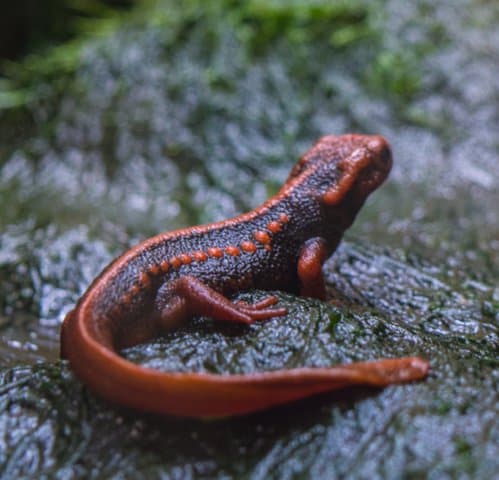
Emperor Newt
Tylototriton shanjing
A highly toxic, black-and-orange newt with bony head ridges from the mountains of western China.
Checking teacher reviews…
About the Emperor Newt
Emperor newts, also called Mandarin or Yunnan newts, are 4.5 to 6 inches long. They are dark brownish-black with orange or yellow markings, bony ridges on the head and back, and a row of warts on each side. They live only in mountains along a few rivers in western Yunnan, China. They eat earthworms, centipedes, snails and other small invertebrates.[1]
Quick facts
- Scientific name
- Tylototriton shanjing[1]
- Size
- 4.5 to 6 inches long.[1]
- Diet
- Earthworms, centipedes, snails and other small invertebrates.[1]
- Habitat
- Mountain land habitats; rice paddies, ponds and wet grasslands for breeding.[1]
- Where it lives
- Western Yunnan province, China.[1]
- Babies
- Eggs attached to rocks and water plants.[1]
- Conservation status
- Vulnerable (IUCN Red List, assessed 2019).[2]
Fun facts
Vocabulary
- toxin
- A poison made by a living thing.
- monsoon
- A season of heavy rain.
- amphibian
- A cold-blooded animal, such as a frog or salamander, that usually starts life in water and has moist skin.
- warning coloration
- Bright colors that tell predators an animal is dangerous to eat.
- vulnerable
- A conservation label meaning a species faces a high risk of dying out in the wild.
See it in person
- Smithsonian's National ZooWashington, D.C. · Reptile Discovery CenterSee this animal on the zoo's website ↗
These zoos had this animal when we gathered our information, but animals sometimes move. Check the zoo's website or contact the zoo before you visit.
Sources
- [1] Smithsonian's National Zoo & Conservation Biology Institute. “Emperor newt.” https://nationalzoo.si.edu/animals/emperor-newt (accessed 2026-10-08)
- [2] IUCN Red List of Threatened Species. “Tylototriton shanjing (Emperor Newt).” https://www.iucnredlist.org/species/59485/63871498 (accessed 2026-10-08)
Facts last checked 2026-10-08.
More Salamanders
 AxolotlAmbystoma mexicanum
 Barred Tiger SalamanderAmbystoma mavortium
 California Tiger SalamanderAmbystoma californiense
 Eastern NewtNotophthalmus viridescens
 Eastern Red-backed SalamanderPlethodon cinereus
 HellbenderCryptobranchus alleganiensis
 Japanese Giant SalamanderAndrias japonicus
 Long-tailed SalamanderEurycea longicauda
 Seal SalamanderDesmognathus monticola
 Shenandoah SalamanderPlethodon shenandoah