
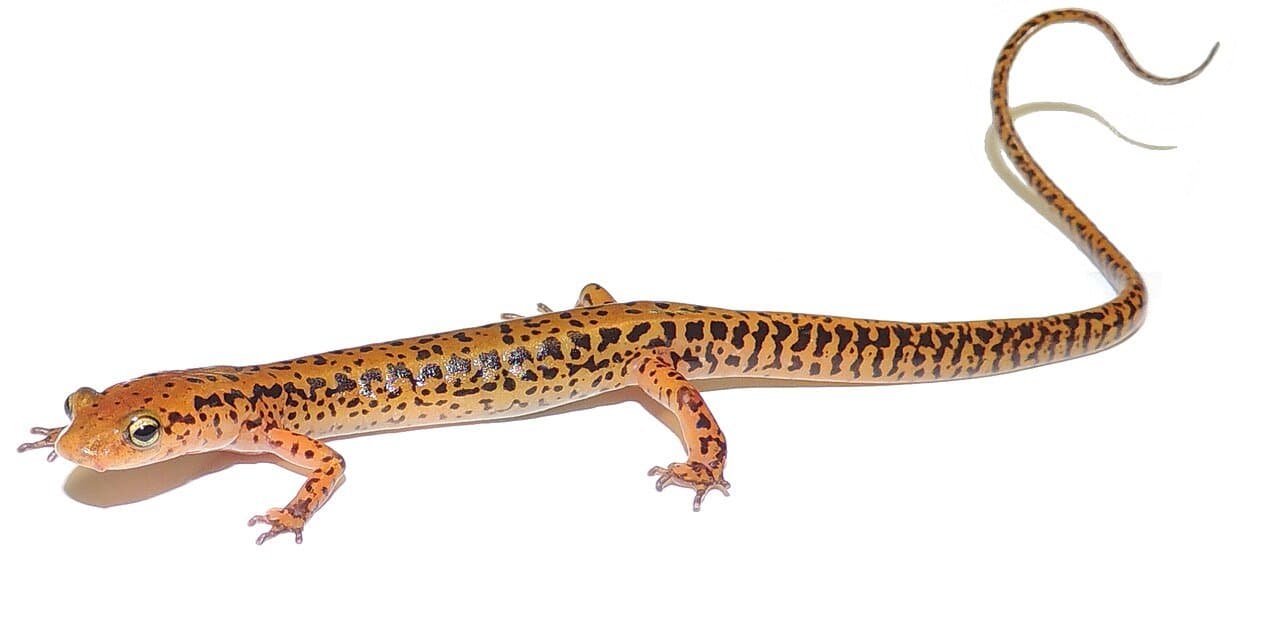
Long-tailed Salamander
Eurycea longicauda
A yellow-orange salamander with black spots whose tail makes up about 60 percent of its length.
Checking teacher reviews…
About the Long-tailed Salamander
Long-tailed salamanders are 4 to 8 inches long, and about 60 percent of that is tail. They are usually yellow, but can be red, orange or brown, with dark dots and dashes. They live from southern New York to northern Alabama and west to Missouri, in creek beds, caves, streams and ponds. Larvae live in water, while adults live in nearby woods. They eat small invertebrates.[1]
Quick facts
- Scientific name
- Eurycea longicauda[1]
- Size
- 4 to 8 inches long, about 60 percent tail.[1]
- Lifespan
- About 10 years.[1]
- Diet
- Small invertebrates.[1]
- Habitat
- Creek beds, caves, streams and ponds, and nearby woods.[1]
- Where it lives
- From southern New York to northern Alabama and west to Missouri.[1]
- Babies
- 60 to 110 eggs laid under rocks in water.[1]
- Conservation status
- Least Concern (IUCN Red List, assessed 2021).[2]
Fun facts
Vocabulary
- amphibian
- A cold-blooded animal, such as a frog or salamander, that usually starts life in water and has moist skin.
- larva
- A young animal that looks very different from the adult, such as a tadpole.
- courtship
- Behavior animals use to attract a mate.
- cold-blooded
- Having a body temperature that changes with the surroundings; also called ectothermic.
- least concern
- A conservation label meaning a species is widespread and not at risk of dying out soon.
See it in person
- Smithsonian's National ZooWashington, D.C. · Reptile Discovery CenterSee this animal on the zoo's website ↗
These zoos had this animal when we gathered our information, but animals sometimes move. Check the zoo's website or contact the zoo before you visit.
Sources
- [1] Smithsonian's National Zoo & Conservation Biology Institute. “Long-tailed salamander.” https://nationalzoo.si.edu/animals/long-tailed-salamander (accessed 2026-10-08)
- [2] IUCN Red List of Threatened Species. “Eurycea longicauda (Longtail Salamander).” https://www.iucnredlist.org/species/59268/196339466 (accessed 2026-10-08)
Facts last checked 2026-10-08.
More Salamanders
 AxolotlAmbystoma mexicanum
 Barred Tiger SalamanderAmbystoma mavortium
 California Tiger SalamanderAmbystoma californiense
 Eastern NewtNotophthalmus viridescens
 Eastern Red-backed SalamanderPlethodon cinereus
 Emperor NewtTylototriton shanjing
 HellbenderCryptobranchus alleganiensis
 Japanese Giant SalamanderAndrias japonicus
 Seal SalamanderDesmognathus monticola
 Shenandoah SalamanderPlethodon shenandoah