
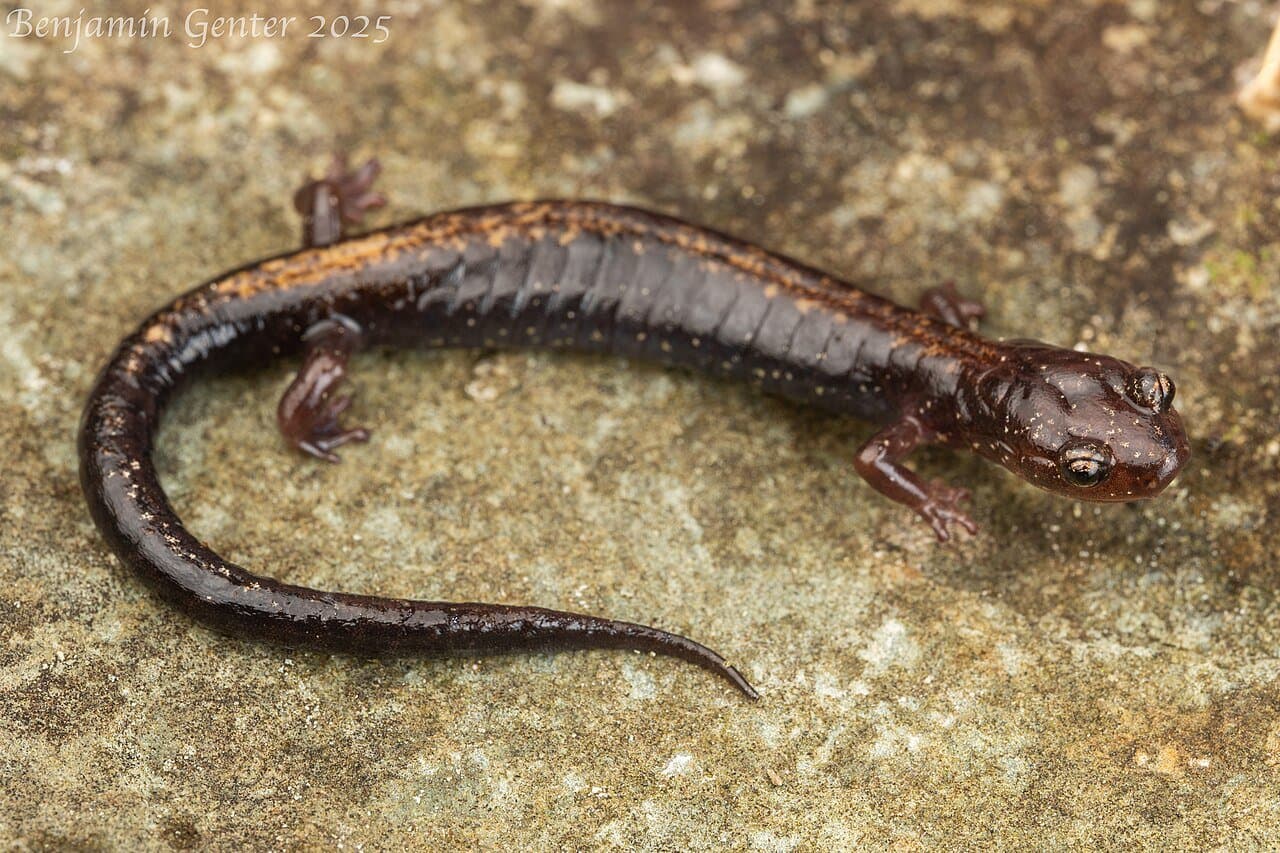
Shenandoah Salamander
Plethodon shenandoah
One of North America's rarest salamanders, found only on three mountaintops in Virginia's Shenandoah National Park.
Checking teacher reviews…
About the Shenandoah Salamander
Shenandoah salamanders are 2.5 to 4 inches long, dark brown to black with a red or bronze stripe down the back. They live only on three mountaintops in Shenandoah National Park, Virginia, at about 3,000 feet or higher, in moist soil pockets among rocks on dry, steep slopes. At night they eat mites, flies, small beetles, springtails and other tiny soil animals.[1]
Quick facts
- Scientific name
- Plethodon shenandoah[1]
- Size
- 2.5 to 4 inches long.[1]
- Lifespan
- Up to about 25 years.[1]
- Diet
- Mites, flies, small beetles, springtails and other tiny soil invertebrates.[1]
- Habitat
- Moist soil pockets and rocks on steep, rocky mountain slopes.[1]
- Where it lives
- Three mountaintops in Shenandoah National Park, Virginia.[1]
- Group life
- Solitary and territorial. Nocturnal.[1]
- Babies
- About 13 eggs every other year; young hatch as tiny adults.[1]
- Conservation status
- Critically Endangered (IUCN Red List, assessed 2021).[2]
Fun facts
Vocabulary
- amphibian
- A cold-blooded animal, such as a frog or salamander, that usually starts life in water and has moist skin.
- lungless
- Having no lungs; some salamanders breathe through their skin.
- endemic
- Found naturally in only one place.
- nocturnal
- Active mainly at night.
- critically endangered
- A conservation label meaning a species faces an extremely high risk of dying out in the wild.
See it in person
- Smithsonian's National ZooWashington, D.C. · Reptile Discovery CenterSee this animal on the zoo's website ↗
These zoos had this animal when we gathered our information, but animals sometimes move. Check the zoo's website or contact the zoo before you visit.
Sources
- [1] Smithsonian's National Zoo & Conservation Biology Institute. “Shenandoah salamander.” https://nationalzoo.si.edu/animals/shenandoah-salamander (accessed 2026-10-08)
- [2] IUCN Red List of Threatened Species. “Plethodon shenandoah (Shenandoah Salamander).” https://www.iucnredlist.org/species/17629/1437677 (accessed 2026-10-08)
Facts last checked 2026-10-08.
More Salamanders
 AxolotlAmbystoma mexicanum
 Barred Tiger SalamanderAmbystoma mavortium
 California Tiger SalamanderAmbystoma californiense
 Eastern NewtNotophthalmus viridescens
 Eastern Red-backed SalamanderPlethodon cinereus
 Emperor NewtTylototriton shanjing
 HellbenderCryptobranchus alleganiensis
 Japanese Giant SalamanderAndrias japonicus
 Long-tailed SalamanderEurycea longicauda
 Seal SalamanderDesmognathus monticola