
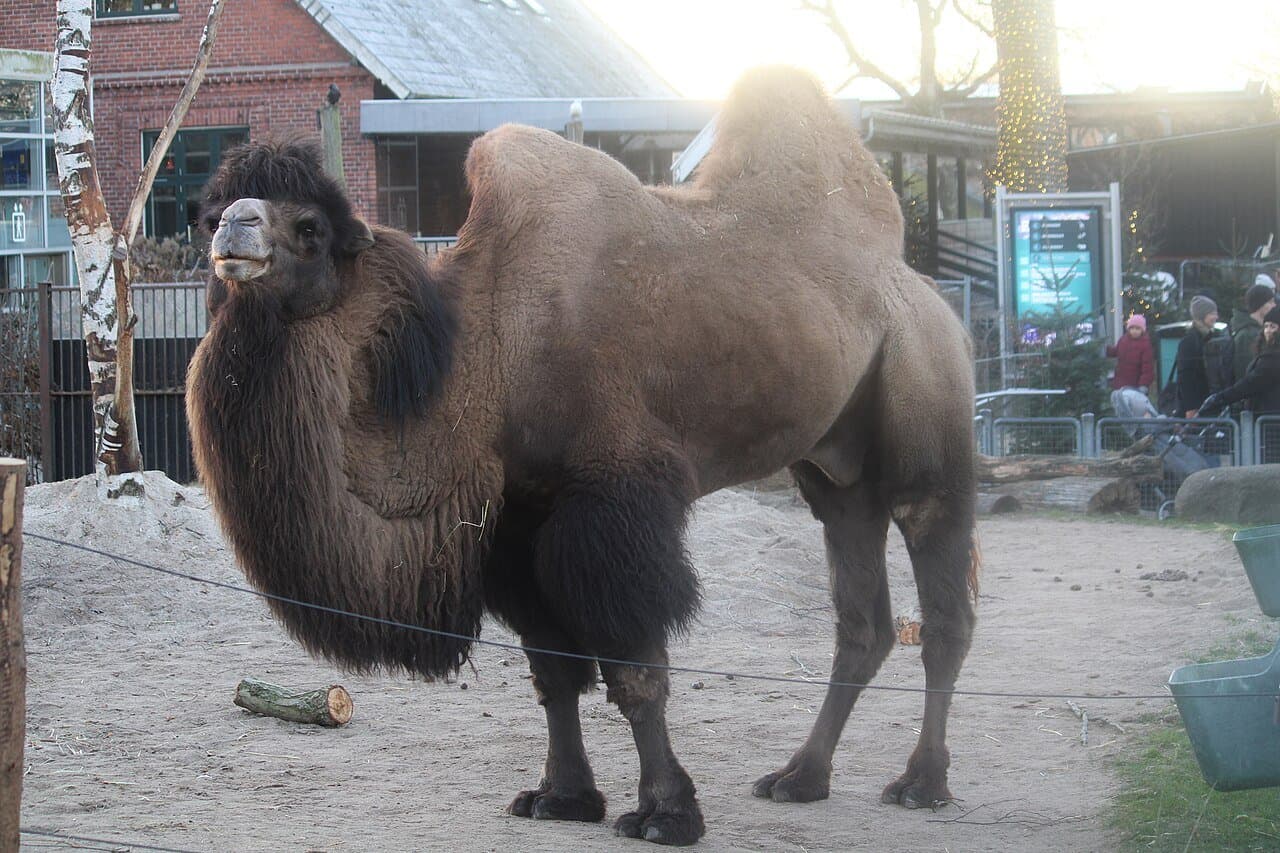
Bactrian Camel
Camelus bactrianus (domestic); wild relative Camelus ferus
A two-humped camel of Central Asian deserts, domesticated thousands of years ago as a pack animal that can go a long time without food or water.
Checking teacher reviews…
About the Bactrian Camel
Bactrian camels stand 7.5 to 8 feet tall and weigh 650 to 1,500 pounds. Long eyelashes, hairy ears and nostrils that close protect them from desert sand and dust, and wide, tough feet help them cross sand. People domesticated camels 4,000 to 6,000 years ago. A camel can carry up to 550 pounds for about 30 miles a day and go a long time without food or water.[1]
Quick facts
- Size
- 7.5 to 8 feet tall and 7 to 11 feet long. Males are larger.[1]
- Weight
- 650 to 1,500 pounds.[1]
- Diet
- Herbivore. Mainly grasses and other plants.[1]
- Habitat
- Wild Bactrian camels live in deserts, grasslands and mountains.[1]
- Where it lives
- Wild Bactrian camels live in the Gobi and Taklamakan deserts of Mongolia and China.[1]
- Group life
- Herds of 6 to 20 led by a dominant male.[1]
- Babies
- Pregnancy lasts about 13 months. Usually one calf, about 80 pounds at birth.[1]
- Conservation status
- Domestic. The wild Bactrian camel is Endangered (IUCN Red List, assessed 2025).[2]
Fun facts
Vocabulary
- domesticated
- Tamed and raised by people over many generations.
- hump
- A mound of fat on a camel's back that stores energy.
- pack animal
- An animal used to carry loads.
- cud
- Food that an animal brings back up from its stomach to chew again.
- endangered
- A conservation label meaning a species faces a very high risk of dying out in the wild.
See it in person
- San Francisco Zoo & GardensSan Francisco, California · MammalsSee this animal on the zoo's website ↗
These zoos had this animal when we gathered our information, but animals sometimes move. Check the zoo's website or contact the zoo before you visit.
Sources
- [1] San Francisco Zoo & Gardens. “Bactrian camel.” https://www.sfzoo.org/bactrian-camel/ (accessed 2026-10-02)
- [2] IUCN Red List of Threatened Species. “Camelus ferus (Wild Camel).” https://www.iucnredlist.org/species/63543/50197851 (accessed 2026-10-02)
Facts last checked 2026-10-02.
More Farm Animals
 American BisonBison bison
 Babydoll Southdown SheepOvis aries
 Black RhinocerosDiceros bicornis
 Chacoan PeccaryCatagonus wagneri
 Cochin ChickenGallus gallus domesticus
 Domestic GoatCapra hircus
 Domestic RabbitOryctolagus cuniculus (domestic)
 Dromedary CamelCamelus dromedarius
 Greater One-Horned RhinocerosRhinoceros unicornis
 Guinea HogSus scrofa domesticus (Guinea hog breed)
 Gulf Coast Native SheepOvis aries
 Huacaya AlpacaVicugna pacos
 Kunekune PigSus scrofa domesticus
 Nigerian Dwarf GoatCapra aegagrus hircus
 Nubian GoatCapra aegagrus hircus
 Oberhasli GoatCapra aegagrus hircus
 Plains ZebraEquus quagga (subspecies include Grant's zebra)
 Przewalski's HorseEquus ferus przewalskii
 Pygmy HippopotamusChoeropsis liberiensis
 Reticulated GiraffeGiraffa reticulata (also listed as Giraffa camelopardalis reticulata)
 Shetland SheepOvis aries (Shetland breed)
 Southern White RhinocerosCeratotherium simum simum
 TakinBudorcas taxicolor