
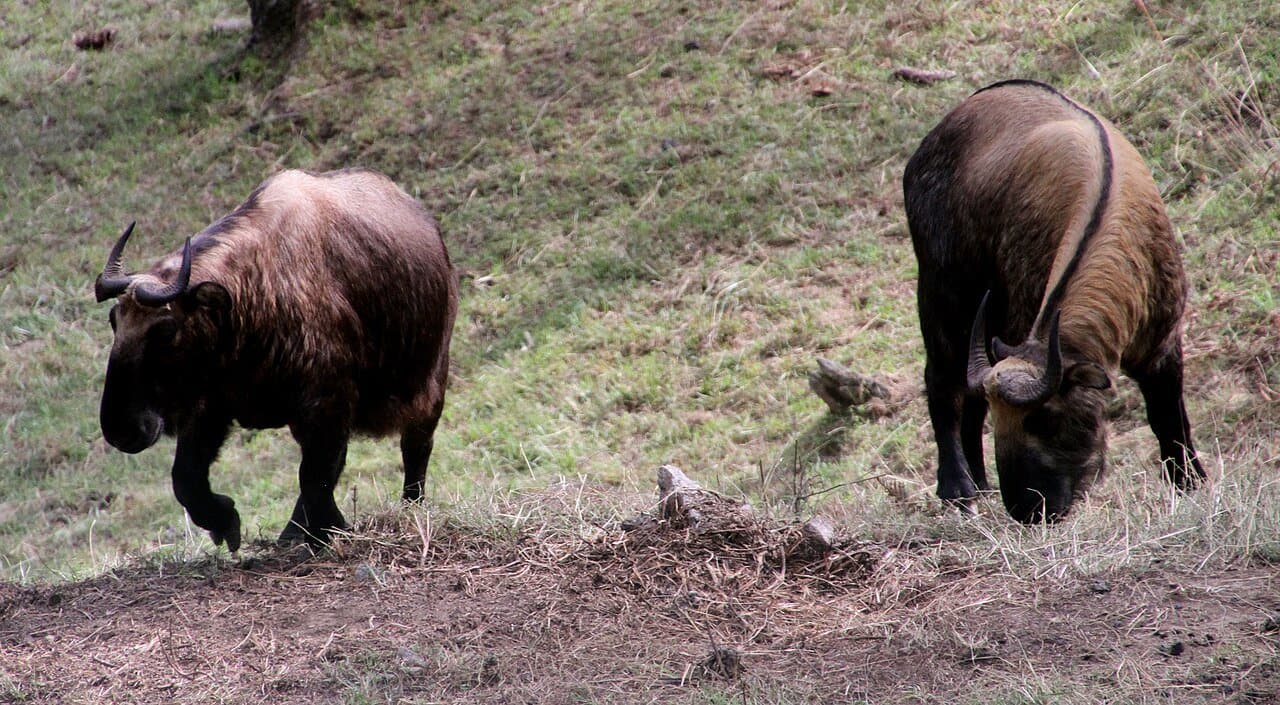
Takin
Budorcas taxicolor
A big, shaggy Himalayan mountain animal with a moose-like nose and horns like a wildebeest, most closely related to sheep.
Checking teacher reviews…
About the Takin
Takins live in the rugged Himalayan Mountains. They stand 3.3 to 4.5 feet tall, and males can weigh up to 770 pounds. Both males and females have shiny black horns up to 35 inches long. Their big nose warms cold air before it reaches the lungs, and their oily skin works like a raincoat. Each spring, herds of up to 300 climb above 14,000 feet, then move back down to forested valleys as it gets cold.[1]
Quick facts
- Scientific name
- Budorcas taxicolor[1]
- Size
- 3.3 to 4.5 feet tall at the shoulder; 5 to 7.3 feet long.[1]
- Weight
- Females up to 616 pounds; males up to 770 pounds.[1]
- Diet
- Herbivore. Grasses, leaves and other plants.[1]
- Habitat
- Mountain forests and alpine meadows.[1]
- Where it lives
- The Himalayan region of Asia.[1]
- Group life
- Herds of up to 300 in spring; smaller groups in cooler months.[1]
- Conservation status
- Vulnerable (IUCN Red List, assessed 2008).[2]
Fun facts
Vocabulary
- sinus
- An air-filled space inside the skull.
- migrate
- To travel from one region to another as the seasons change.
- rut
- The mating season of hoofed animals.
- tree line
- The height on a mountain above which trees can't grow.
- vulnerable
- A conservation label meaning a species faces a high risk of dying out in the wild.
See it in person
- Omaha's Henry Doorly Zoo and AquariumOmaha, Nebraska · Asian HighlandsSee this area on the zoo's website ↗
These zoos had this animal when we gathered our information, but animals sometimes move. Check the zoo's website or contact the zoo before you visit.
Sources
- [1] San Diego Zoo Wildlife Alliance. “Takin.” https://animals.sandiegozoo.org/animals/takin (accessed 2026-10-02)
- [2] IUCN Red List of Threatened Species. “Budorcas taxicolor (Takin).” https://www.iucnredlist.org/species/3160/9643719 (accessed 2026-10-02)
Facts last checked 2026-10-02.
More Hoofed Mammals
 American BisonBison bison
 Babydoll Southdown SheepOvis aries
 Bactrian CamelCamelus bactrianus (domestic); wild relative Camelus ferus
 Black RhinocerosDiceros bicornis
 Chacoan PeccaryCatagonus wagneri
 Domestic GoatCapra hircus
 Dromedary CamelCamelus dromedarius
 Greater One-Horned RhinocerosRhinoceros unicornis
 Gulf Coast Native SheepOvis aries
 Huacaya AlpacaVicugna pacos
 Nigerian Dwarf GoatCapra aegagrus hircus
 Nubian GoatCapra aegagrus hircus
 Oberhasli GoatCapra aegagrus hircus
 Plains ZebraEquus quagga (subspecies include Grant's zebra)
 Przewalski's HorseEquus ferus przewalskii
 Pygmy HippopotamusChoeropsis liberiensis
 Reticulated GiraffeGiraffa reticulata (also listed as Giraffa camelopardalis reticulata)
 Shetland SheepOvis aries (Shetland breed)
 Southern White RhinocerosCeratotherium simum simum