Reticulated Giraffe
Giraffa reticulata (also listed as Giraffa camelopardalis reticulata)
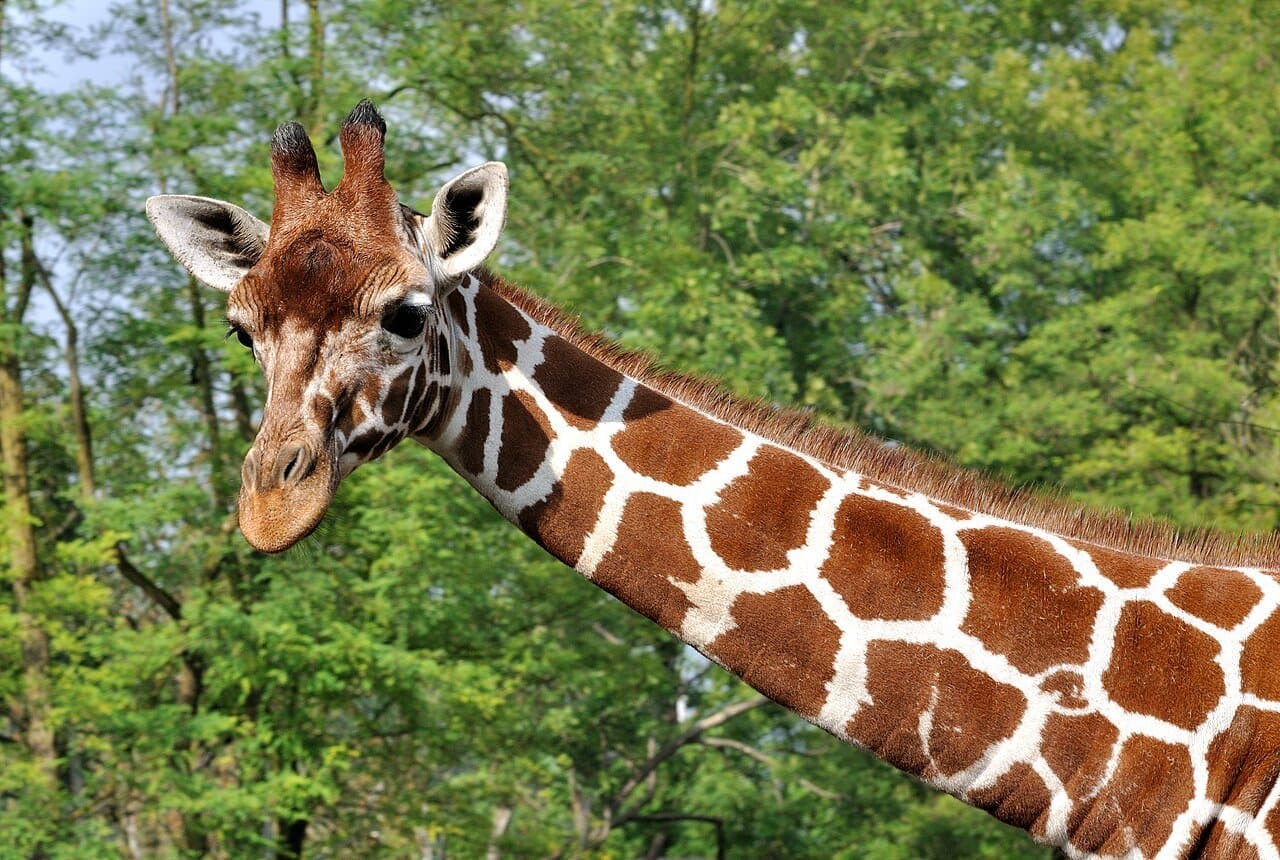
An endangered giraffe of northern Kenya with orange-brown patches outlined by a network of bright white lines.
About the Reticulated Giraffe
Reticulated giraffes live mainly in northern and northeastern Kenya. Their coats have orange-brown patches outlined by bright white lines that run all the way down their legs. A giraffe's favorite food is acacia leaves. It uses an 18-inch tongue and flexible lips to reach around the sharp thorns, and it can eat up to 75 pounds of food in a day. A baby giraffe is already about 6 feet tall when it is born.[1][3]
Quick facts
- Size
- Giraffes stand up to 14 feet (4.3 m) tall for females and up to 18 feet (5.5 m) for males.[1]
- Weight
- Females up to 1,500 pounds (680 kg). Males up to 3,000 pounds (1,360 kg).[1]
- Lifespan
- 15 to 20 years.[1]
- Diet
- Herbivore. Favorite food is acacia leaves. Can eat up to 75 pounds (34 kg) of food a day.[1]
- Habitat
- Open plains dotted with trees.[1]
- Where it lives
- Mainly northern and northeastern Kenya, with a few small groups possibly left in southern Somalia and Ethiopia.[3]
- Babies
- Pregnancy lasts about 14 months. A newborn calf is about 6 feet (1.8 m) tall and weighs 100 to 220 pounds (45 to 100 kg).[1]
Fun facts
- A giraffe's tongue is about 18 inches (46 cm) long. Its dark color helps protect it from sunburn.[1]
- Giraffes need only 5 to 30 minutes of sleep in a 24-hour day.[1]
- A giraffe has seven neck bones, and each one can be more than 10 inches (25 cm) long.[1]
- The horn-like bumps on a giraffe's head are covered in hair and are called ossicones.[1]
- Thick, sticky saliva coats any acacia thorns a giraffe swallows.[1]
Vocabulary
- reticulated
- Marked with a pattern of lines that form a net or web.
- ossicone
- A bony, hair-covered horn on top of a giraffe's head.
- browse
- To feed on leaves, twigs and shoots from trees and bushes.
- prehensile
- Able to grab or wrap around things, like a giraffe's lips.
- endangered
- A conservation label meaning a species faces a very high risk of dying out in the wild.
See it in person
- Montgomery ZooMontgomery, Alabama · AfricaSee this area on the zoo's website ↗
- Zoo AtlantaAtlanta, Georgia · All AnimalsSee this animal on the zoo's website ↗
- San Francisco Zoo & GardensSan Francisco, California · MammalsSee this animal on the zoo's website ↗
- Oakland ZooOakland, California · African SavannaSee this animal on the zoo's website ↗
These zoos had this animal when we gathered our information, but animals sometimes move. Check the zoo's website or contact the zoo before you visit.
Sources
- [1] San Diego Zoo Wildlife Alliance. “Giraffe.” https://animals.sandiegozoo.org/animals/giraffe (accessed 2026-10-02)
- [2] African Wildlife Foundation. “Giraffe.” https://www.awf.org/wildlife-conservation/giraffe (accessed 2026-10-02)
- [3] Giraffe Conservation Foundation. “Reticulated giraffe.” https://giraffeconservation.org/giraffe-species/reticulated-giraffe/ (accessed 2026-10-02)
- [4] IUCN Red List of Threatened Species. “Giraffa camelopardalis ssp. reticulata (Reticulated Giraffe).” https://www.iucnredlist.org/species/88420717/88420720 (accessed 2026-10-02)
Facts last checked 2026-10-02.
More Hoofed Mammals
 American BisonBison bison
 Babydoll Southdown SheepOvis aries
 Bactrian CamelCamelus bactrianus (domestic); wild relative Camelus ferus
 Black RhinocerosDiceros bicornis
 Chacoan PeccaryCatagonus wagneri
 Domestic GoatCapra hircus
 Dromedary CamelCamelus dromedarius
 Greater One-Horned RhinocerosRhinoceros unicornis
 Gulf Coast Native SheepOvis aries
 Huacaya AlpacaVicugna pacos
 Nigerian Dwarf GoatCapra aegagrus hircus
 Nubian GoatCapra aegagrus hircus
 Oberhasli GoatCapra aegagrus hircus
 Plains ZebraEquus quagga (subspecies include Grant's zebra)
 Przewalski's HorseEquus ferus przewalskii
 Pygmy HippopotamusChoeropsis liberiensis
 Shetland SheepOvis aries (Shetland breed)
 Southern White RhinocerosCeratotherium simum simum
 TakinBudorcas taxicolor