
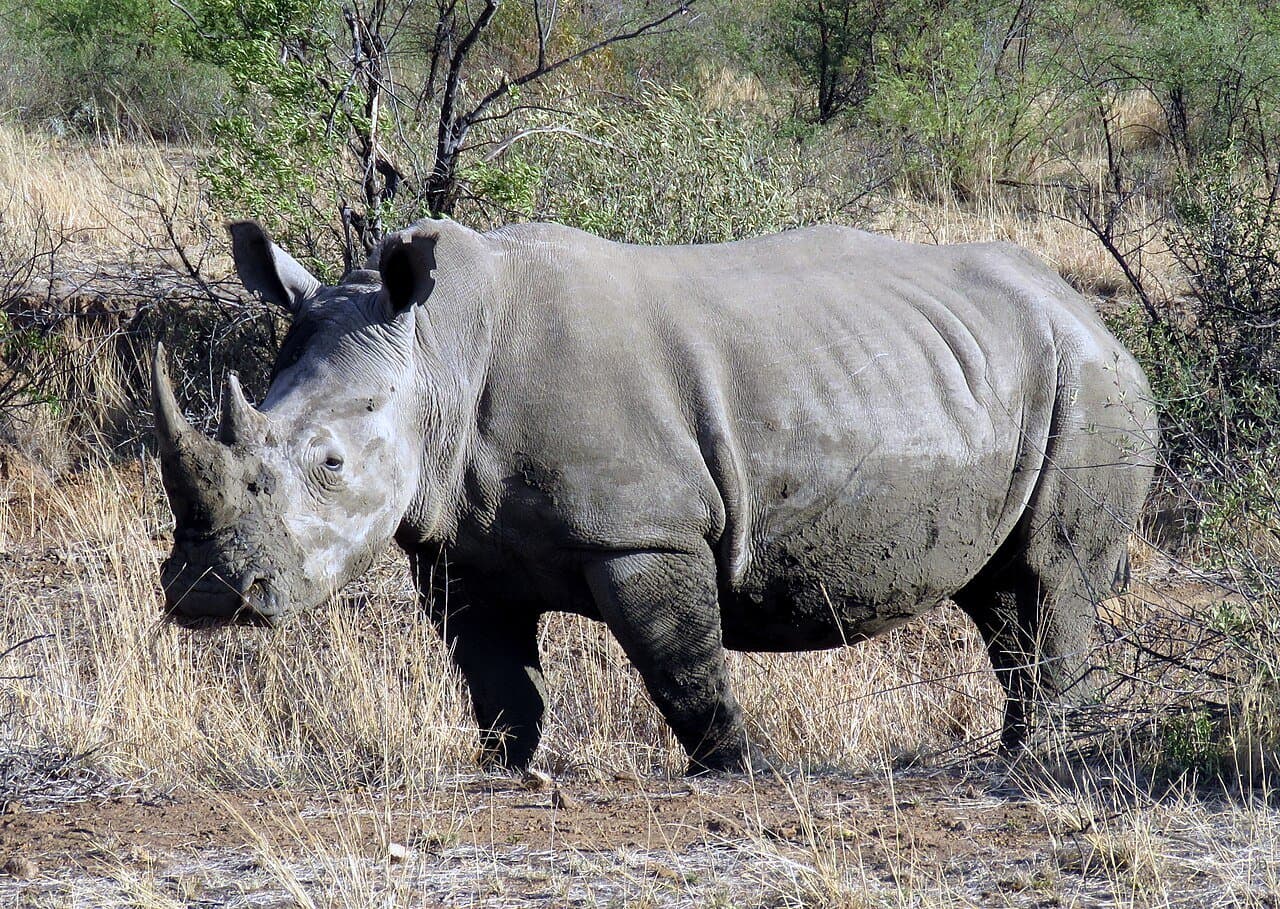
Southern White Rhinoceros
Ceratotherium simum simum
The largest rhino, a wide-lipped grass grazer of southern Africa that came back from near extinction to about 20,000 animals.
Checking teacher reviews…
About the Southern White Rhinoceros
Southern white rhinos live in grassy savannas of middle and southern Africa, mostly in South Africa. They are the largest rhinos, up to 6 feet tall and 6,000 pounds. Their wide, square upper lip lets them graze on short grass. The name "white" comes from an Afrikaans word meaning "wide." White rhinos are the most social rhinos, and calves stay with their mothers until the next calf is born.[1]
Quick facts
- Scientific name
- Ceratotherium simum simum[1]
- Size
- Up to 6 feet tall at the shoulder. Front horn averages 35 inches, up to 60.[1]
- Weight
- Up to 6,000 pounds.[1]
- Lifespan
- 40 to 50 years.[1]
- Diet
- Herbivore. A grazer that eats short grasses.[1]
- Habitat
- Grassland savannas.[1]
- Where it lives
- Middle and southern Africa, mostly South Africa.[1]
- Group life
- The most social rhino. Dominant males are usually solitary.[1]
- Babies
- One calf after about 16 months. Calves are weaned at 1 to 2 years.[1]
- Conservation status
- Near Threatened (IUCN Red List, assessed 2020).[2]
Fun facts
Vocabulary
- graze
- To feed on grass growing in a field.
- Afrikaans
- A language spoken in South Africa and Namibia.
- poaching
- Hunting or capturing animals illegally.
- functionally extinct
- So few left that the species can no longer survive on its own.
- near threatened
- A conservation label meaning a species may become threatened soon.
See it in person
- Zoo AtlantaAtlanta, Georgia · All AnimalsSee this animal on the zoo's website ↗
- Omaha's Henry Doorly Zoo and AquariumOmaha, Nebraska · Scott African GrasslandsSee this area on the zoo's website ↗
These zoos had this animal when we gathered our information, but animals sometimes move. Check the zoo's website or contact the zoo before you visit.
Sources
- [1] Zoo Atlanta. “Southern White Rhinoceros.” https://zooatlanta.org/animal/southern-white-rhinoceros/ (accessed 2026-10-02)
- [2] IUCN Red List of Threatened Species. “Ceratotherium simum ssp. simum (Southern White Rhinoceros).” https://www.iucnredlist.org/species/39317/45814320 (accessed 2026-10-02)
Facts last checked 2026-10-02.
More Hoofed Mammals
 American BisonBison bison
 Babydoll Southdown SheepOvis aries
 Bactrian CamelCamelus bactrianus (domestic); wild relative Camelus ferus
 Black RhinocerosDiceros bicornis
 Chacoan PeccaryCatagonus wagneri
 Domestic GoatCapra hircus
 Dromedary CamelCamelus dromedarius
 Greater One-Horned RhinocerosRhinoceros unicornis
 Gulf Coast Native SheepOvis aries
 Huacaya AlpacaVicugna pacos
 Nigerian Dwarf GoatCapra aegagrus hircus
 Nubian GoatCapra aegagrus hircus
 Oberhasli GoatCapra aegagrus hircus
 Plains ZebraEquus quagga (subspecies include Grant's zebra)
 Przewalski's HorseEquus ferus przewalskii
 Pygmy HippopotamusChoeropsis liberiensis
 Reticulated GiraffeGiraffa reticulata (also listed as Giraffa camelopardalis reticulata)
 Shetland SheepOvis aries (Shetland breed)
 TakinBudorcas taxicolor