
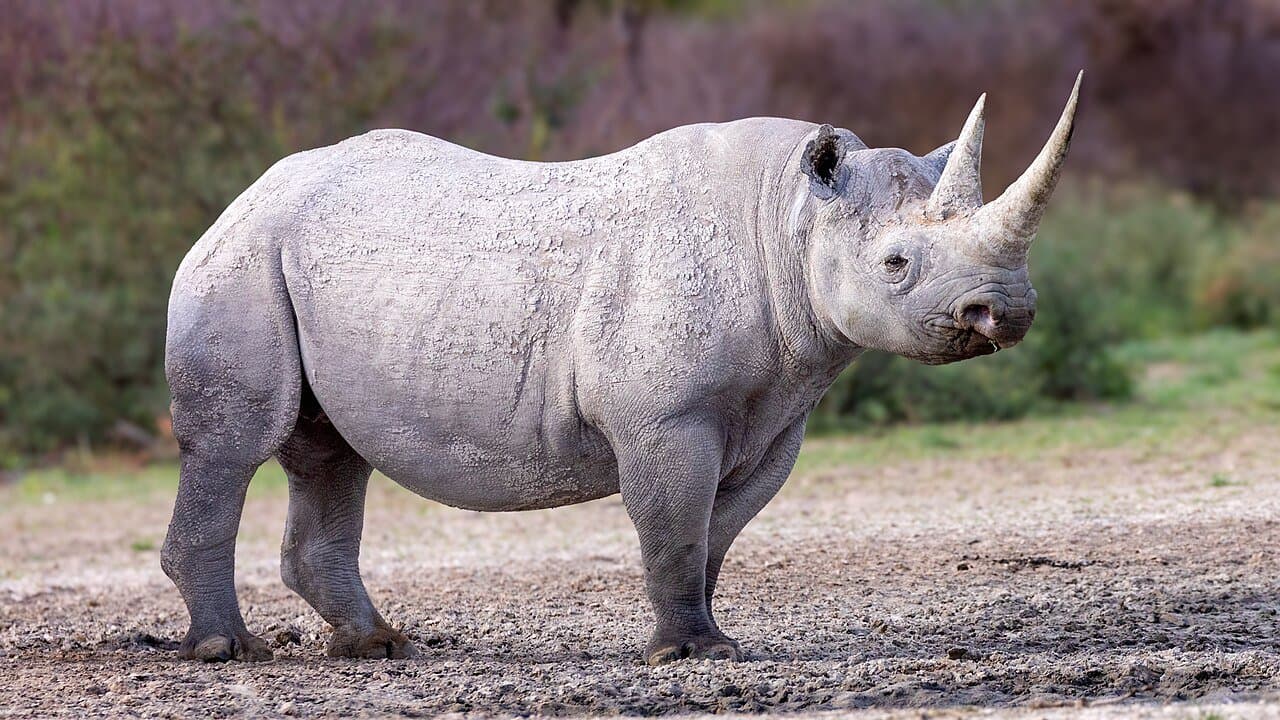
Black Rhinoceros
Diceros bicornis
A critically endangered two-horned rhino of eastern and southern Africa that browses on shrubs with a pointed, grasping lip.
Checking teacher reviews…
About the Black Rhinoceros
Black rhinos live in eastern and southern Africa, in bushy plains, thick brush, open forests and grassy plains, always near water. Adults weigh up to 3,000 pounds. They are browsers that use a pointed, grasping upper lip to strip leaves off thorny bushes like acacia. Both black and white rhinos are actually gray; their color can depend on the mud they've rolled in.[1]
Quick facts
- Scientific name
- Diceros bicornis[1]
- Size
- 10 to 12.5 feet long. Front horn up to 50 inches.[1]
- Weight
- Up to 3,000 pounds.[1]
- Lifespan
- 35 to 50 years in the wild.[1]
- Diet
- Herbivore. A browser that eats bushes, shrubs, acacia, twigs and new growth.[1]
- Habitat
- Bushy plains, dense brush, open forests and grassy plains near water.[1]
- Where it lives
- Eastern and southern Africa, including South Africa, Namibia and Zimbabwe.[1]
- Group life
- Feeds in the morning and evening; rests in shade or mud in the heat of the day.[1]
- Conservation status
- Critically Endangered (IUCN Red List, assessed 2020).[2]
Fun facts
Vocabulary
- browser
- An animal that eats leaves, twigs and shoots from bushes and trees.
- prehensile
- Able to grab or wrap around things, like a black rhino's upper lip.
- nearsighted
- Able to see close things clearly but not things far away.
- wallow
- A muddy spot where an animal rolls or rests to stay cool.
- critically endangered
- A conservation label meaning a species faces an extremely high risk of dying out in the wild.
See it in person
- San Francisco Zoo & GardensSan Francisco, California · MammalsSee this animal on the zoo's website ↗
These zoos had this animal when we gathered our information, but animals sometimes move. Check the zoo's website or contact the zoo before you visit.
Sources
- [1] San Francisco Zoo & Gardens. “Black Rhinoceros.” https://www.sfzoo.org/black-rhinoceros/ (accessed 2026-10-02)
- [2] IUCN Red List of Threatened Species. “Diceros bicornis (Black Rhinoceros).” https://www.iucnredlist.org/species/6557/152728945 (accessed 2026-10-02)
Facts last checked 2026-10-02.
More Hoofed Mammals
 American BisonBison bison
 Babydoll Southdown SheepOvis aries
 Bactrian CamelCamelus bactrianus (domestic); wild relative Camelus ferus
 Chacoan PeccaryCatagonus wagneri
 Domestic GoatCapra hircus
 Dromedary CamelCamelus dromedarius
 Greater One-Horned RhinocerosRhinoceros unicornis
 Gulf Coast Native SheepOvis aries
 Huacaya AlpacaVicugna pacos
 Nigerian Dwarf GoatCapra aegagrus hircus
 Nubian GoatCapra aegagrus hircus
 Oberhasli GoatCapra aegagrus hircus
 Plains ZebraEquus quagga (subspecies include Grant's zebra)
 Przewalski's HorseEquus ferus przewalskii
 Pygmy HippopotamusChoeropsis liberiensis
 Reticulated GiraffeGiraffa reticulata (also listed as Giraffa camelopardalis reticulata)
 Shetland SheepOvis aries (Shetland breed)
 Southern White RhinocerosCeratotherium simum simum
 TakinBudorcas taxicolor