
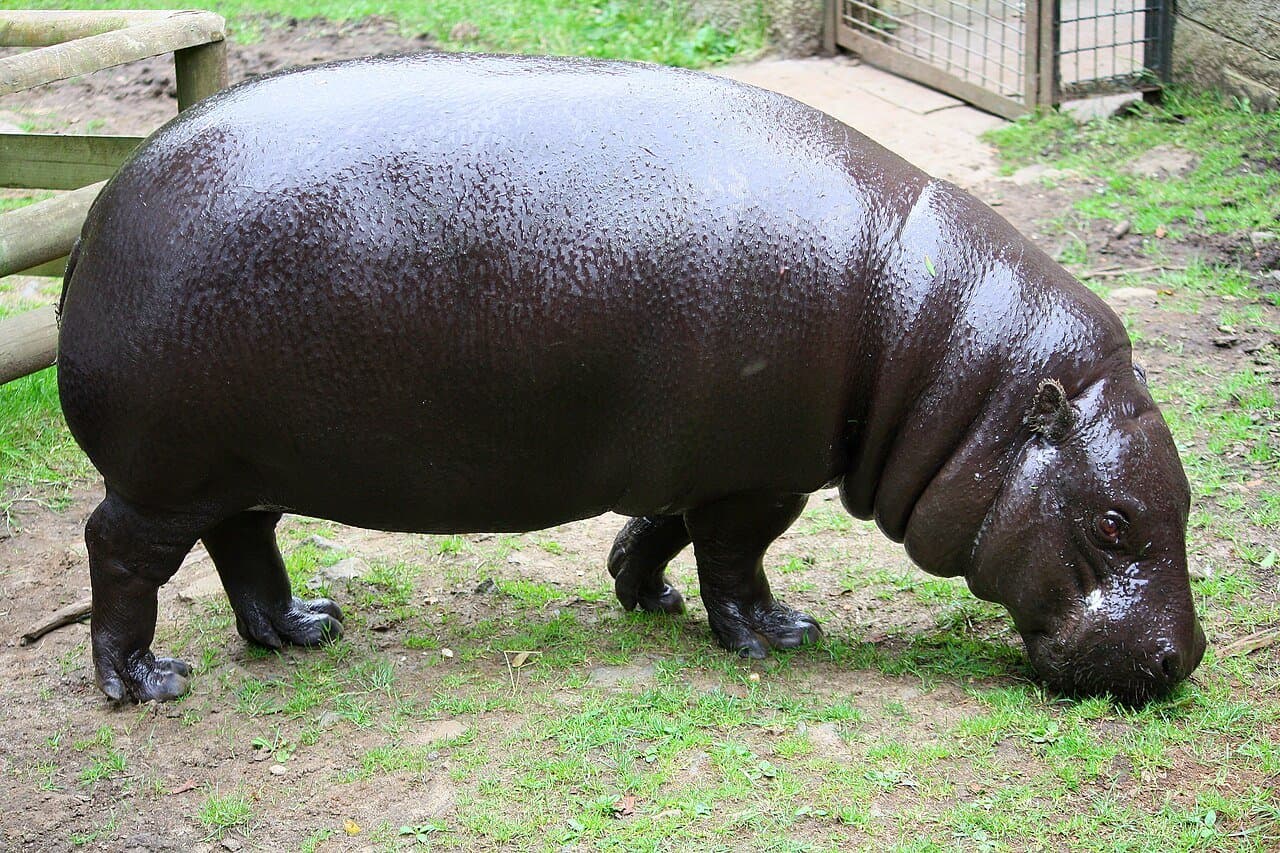
Pygmy Hippopotamus
Choeropsis liberiensis
A small, shy, endangered hippo that lives alone in the forests and swamps of West Africa, mostly in Liberia.
Checking teacher reviews…
About the Pygmy Hippopotamus
Pygmy hippos live in forests near rivers and swamps in West Africa, mostly in Liberia. They are much smaller than common hippos, standing only 30 to 39 inches tall. Pygmy hippos are usually alone and mostly active at night, when they eat leaves, roots, ferns and fruit. Their skin makes a pink liquid, sometimes called "blood sweat," that helps protect them from sunburn. A baby can drink its mother's milk on land or underwater.[1]
Quick facts
- Scientific name
- Choeropsis liberiensis[1]
- Size
- 30 to 39 inches (75 to 100 cm) tall. 4.9 to 5.7 feet (1.5 to 1.75 m) long.[1]
- Weight
- 350 to 600 pounds (160 to 270 kg).[1]
- Lifespan
- Females live about 31 years on average. Unknown for males.[1]
- Diet
- Herbivore. Leaves, roots, ferns and fruits found near rivers and streams.[1]
- Habitat
- Forests, near rivers, streams and swamps.[1]
- Where it lives
- West Africa, mainly Liberia, with small numbers in Sierra Leone, Guinea and Ivory Coast.[1]
- Group life
- Usually solitary and mainly active at night.[1]
- Babies
- Pregnancy lasts 6 to 7 months. A newborn weighs 7.5 to 14 pounds (3.4 to 6.4 kg).[1]
Fun facts
- Pygmy hippos give off a pink liquid that looks like sweat and helps protect their skin from sunburn.[1]
- A pygmy hippo calf can nurse from its mother on land or underwater.[1]
- Pygmy hippos have less webbing between their toes than common hippos.[1]
- During the heat of the day, pygmy hippos rest hidden in swamps, wallows or rivers.[1]
Vocabulary
- nocturnal
- Active at night and resting during the day.
- solitary
- Living alone rather than in a group.
- incisor
- A front tooth used for cutting or biting.
- wallow
- A muddy or wet spot where an animal rolls or rests to stay cool.
- endangered
- A conservation label meaning a species faces a very high risk of dying out in the wild.
See it in person
- Montgomery ZooMontgomery, Alabama · AfricaSee this area on the zoo's website ↗
- Montgomery ZooMontgomery, Alabama · AustraliaSee this area on the zoo's website ↗
- Omaha's Henry Doorly Zoo and AquariumOmaha, Nebraska · Lied JungleSee this area on the zoo's website ↗
These zoos had this animal when we gathered our information, but animals sometimes move. Check the zoo's website or contact the zoo before you visit.
Sources
- [1] San Diego Zoo Wildlife Alliance. “Pygmy Hippopotamus.” https://animals.sandiegozoo.org/animals/pygmy-hippopotamus (accessed 2026-10-02)
- [2] IUCN Red List of Threatened Species. “Choeropsis liberiensis (Pygmy Hippopotamus).” https://www.iucnredlist.org/species/10032/18567171 (accessed 2026-10-02)
Facts last checked 2026-10-02.
More Hoofed Mammals
 American BisonBison bison
 Babydoll Southdown SheepOvis aries
 Bactrian CamelCamelus bactrianus (domestic); wild relative Camelus ferus
 Black RhinocerosDiceros bicornis
 Chacoan PeccaryCatagonus wagneri
 Domestic GoatCapra hircus
 Dromedary CamelCamelus dromedarius
 Greater One-Horned RhinocerosRhinoceros unicornis
 Gulf Coast Native SheepOvis aries
 Huacaya AlpacaVicugna pacos
 Nigerian Dwarf GoatCapra aegagrus hircus
 Nubian GoatCapra aegagrus hircus
 Oberhasli GoatCapra aegagrus hircus
 Plains ZebraEquus quagga (subspecies include Grant's zebra)
 Przewalski's HorseEquus ferus przewalskii
 Reticulated GiraffeGiraffa reticulata (also listed as Giraffa camelopardalis reticulata)
 Shetland SheepOvis aries (Shetland breed)
 Southern White RhinocerosCeratotherium simum simum
 TakinBudorcas taxicolor