
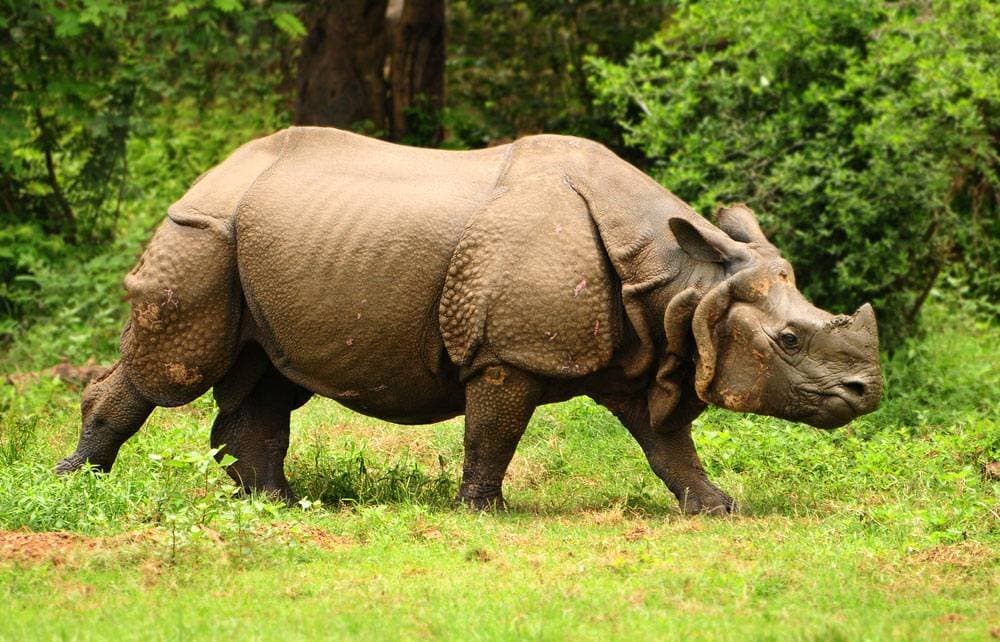
Greater One-Horned Rhinoceros
Rhinoceros unicornis
A huge, armor-looking rhino of India and Nepal with a single horn, whose numbers have recovered from about 150 animals to thousands.
Checking teacher reviews…
About the Greater One-Horned Rhinoceros
Greater one-horned rhinos, also called Indian rhinos, live in the grasslands of northeastern India and southern Nepal. A male can weigh about 2,200 kg (4,850 pounds). They eat 150 to 200 kg of grasses, flowers, fruit and twigs each day. Rhinos usually live alone and spend time wallowing in mud and water, which helps them stay cool and keeps them from drying out.[1]
Quick facts
- Scientific name
- Rhinoceros unicornis[1]
- Size
- Males 3.7 to 3.8 m long and 1.70 to 1.86 m tall at the shoulder. Females are smaller.[1]
- Weight
- Males about 2,200 kg (4,850 pounds). Females about 1,600 kg (3,530 pounds).[1]
- Lifespan
- Up to about 40 years in the wild.[1]
- Diet
- Herbivore. Grasses, flowers, fruit, twigs and branches: 150 to 200 kg a day.[1]
- Habitat
- Wet floodplain grasslands and dry savanna grasslands.[1]
- Where it lives
- Northeastern India and parts of southern Nepal.[1]
- Group life
- Usually solitary. Most active in the early morning, late afternoon and at night.[1]
- Babies
- Pregnancy lasts 425 to 496 days (about 15 to 16 months). A newborn calf weighs 40 to 81 kg.[1]
- Conservation status
- Vulnerable (IUCN Red List, assessed 2018).[2]
Fun facts
Vocabulary
- keratin
- A tough protein that makes up hair, nails, hooves and horns.
- wallow
- To roll around or lie in mud or water.
- poaching
- Hunting or capturing animals illegally.
- floodplain
- Flat land next to a river that floods during the rainy season.
- vulnerable
- A conservation label meaning a species faces a high risk of dying out in the wild.
See it in person
- Montgomery ZooMontgomery, Alabama · AsiaSee this area on the zoo's website ↗
- San Francisco Zoo & GardensSan Francisco, California · MammalsSee this animal on the zoo's website ↗
- Omaha's Henry Doorly Zoo and AquariumOmaha, Nebraska · Asian HighlandsSee this area on the zoo's website ↗
These zoos had this animal when we gathered our information, but animals sometimes move. Check the zoo's website or contact the zoo before you visit.
Sources
- [1] Animal Diversity Web, University of Michigan Museum of Zoology. “Rhinoceros unicornis (Indian rhinoceros).” https://animaldiversity.org/accounts/Rhinoceros_unicornis/ (accessed 2026-10-02)
- [2] IUCN Red List of Threatened Species. “Rhinoceros unicornis (Greater One-horned Rhino).” https://www.iucnredlist.org/species/19496/18494149 (accessed 2026-10-02)
Facts last checked 2026-10-02.
More Hoofed Mammals
 American BisonBison bison
 Babydoll Southdown SheepOvis aries
 Bactrian CamelCamelus bactrianus (domestic); wild relative Camelus ferus
 Black RhinocerosDiceros bicornis
 Chacoan PeccaryCatagonus wagneri
 Domestic GoatCapra hircus
 Dromedary CamelCamelus dromedarius
 Gulf Coast Native SheepOvis aries
 Huacaya AlpacaVicugna pacos
 Nigerian Dwarf GoatCapra aegagrus hircus
 Nubian GoatCapra aegagrus hircus
 Oberhasli GoatCapra aegagrus hircus
 Plains ZebraEquus quagga (subspecies include Grant's zebra)
 Przewalski's HorseEquus ferus przewalskii
 Pygmy HippopotamusChoeropsis liberiensis
 Reticulated GiraffeGiraffa reticulata (also listed as Giraffa camelopardalis reticulata)
 Shetland SheepOvis aries (Shetland breed)
 Southern White RhinocerosCeratotherium simum simum
 TakinBudorcas taxicolor