
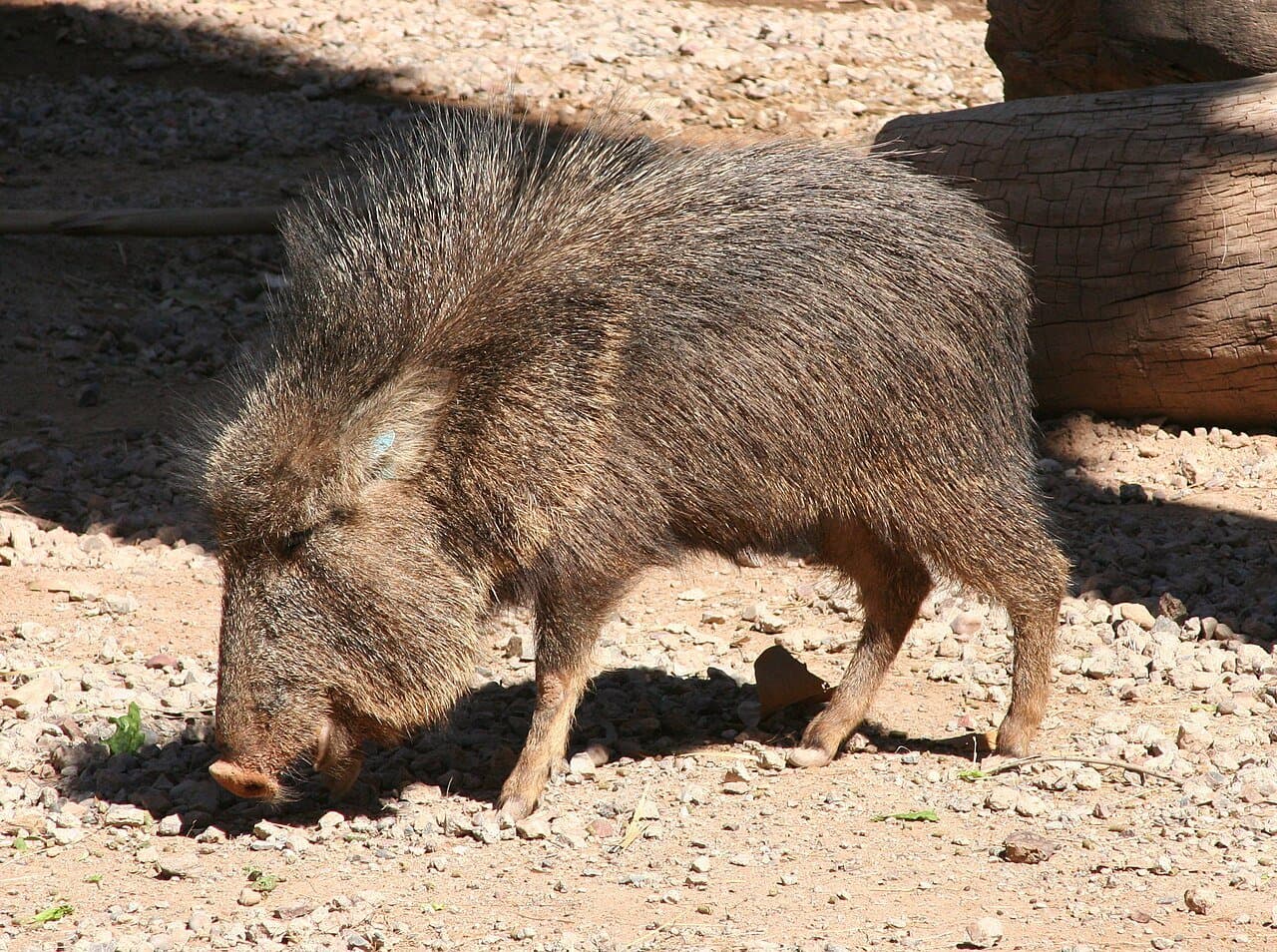
Chacoan Peccary
Catagonus wagneri
A pig-like hoofed mammal of South America's dry Gran Chaco, known only from fossils until it was found alive in 1975.
Checking teacher reviews…
About the Chacoan Peccary
Chacoan peccaries live in the Gran Chaco, a hot, dry plain covered with cactus and thorny bushes in Paraguay, Bolivia and Argentina. They use their tough snouts to roll cactus on the ground and knock off the spines, and they dig up roots. They get most of their water from their food. Peccaries live in small groups of two to ten.[1]
Quick facts
- Scientific name
- Catagonus wagneri[1]
- Lifespan
- About 9 years in the wild. Up to 18 in human care.[1]
- Diet
- Herbivore. Cactus and roots, plus mineral-rich soil.[1]
- Habitat
- Hot, dry plain with cactus and thorny bushes.[1]
- Where it lives
- The Gran Chaco of Paraguay, Bolivia and Argentina.[1]
- Group life
- Small groups of two to ten. Active mostly during the day.[1]
- Conservation status
- Endangered (IUCN Red List, assessed 2011).[2]
Fun facts
Vocabulary
- peccary
- A pig-like hoofed mammal of the Americas.
- fossil
- The preserved remains or traces of an animal or plant from long ago.
- snout
- The long nose and mouth of an animal.
- mineral
- A natural substance, like salt, that bodies need to stay healthy.
- endangered
- A conservation label meaning a species faces a very high risk of dying out in the wild.
See it in person
- San Francisco Zoo & GardensSan Francisco, California · MammalsSee this animal on the zoo's website ↗
These zoos had this animal when we gathered our information, but animals sometimes move. Check the zoo's website or contact the zoo before you visit.
Sources
- [1] San Francisco Zoo & Gardens. “Chacoan Peccary.” https://www.sfzoo.org/chacoan-peccary/ (accessed 2026-10-02)
- [2] IUCN Red List of Threatened Species. “Catagonus wagneri (Chacoan Peccary).” https://www.iucnredlist.org/species/4015/72587993 (accessed 2026-10-02)
Facts last checked 2026-10-02.
More Hoofed Mammals
 American BisonBison bison
 Babydoll Southdown SheepOvis aries
 Bactrian CamelCamelus bactrianus (domestic); wild relative Camelus ferus
 Black RhinocerosDiceros bicornis
 Domestic GoatCapra hircus
 Dromedary CamelCamelus dromedarius
 Greater One-Horned RhinocerosRhinoceros unicornis
 Gulf Coast Native SheepOvis aries
 Huacaya AlpacaVicugna pacos
 Nigerian Dwarf GoatCapra aegagrus hircus
 Nubian GoatCapra aegagrus hircus
 Oberhasli GoatCapra aegagrus hircus
 Plains ZebraEquus quagga (subspecies include Grant's zebra)
 Przewalski's HorseEquus ferus przewalskii
 Pygmy HippopotamusChoeropsis liberiensis
 Reticulated GiraffeGiraffa reticulata (also listed as Giraffa camelopardalis reticulata)
 Shetland SheepOvis aries (Shetland breed)
 Southern White RhinocerosCeratotherium simum simum
 TakinBudorcas taxicolor