
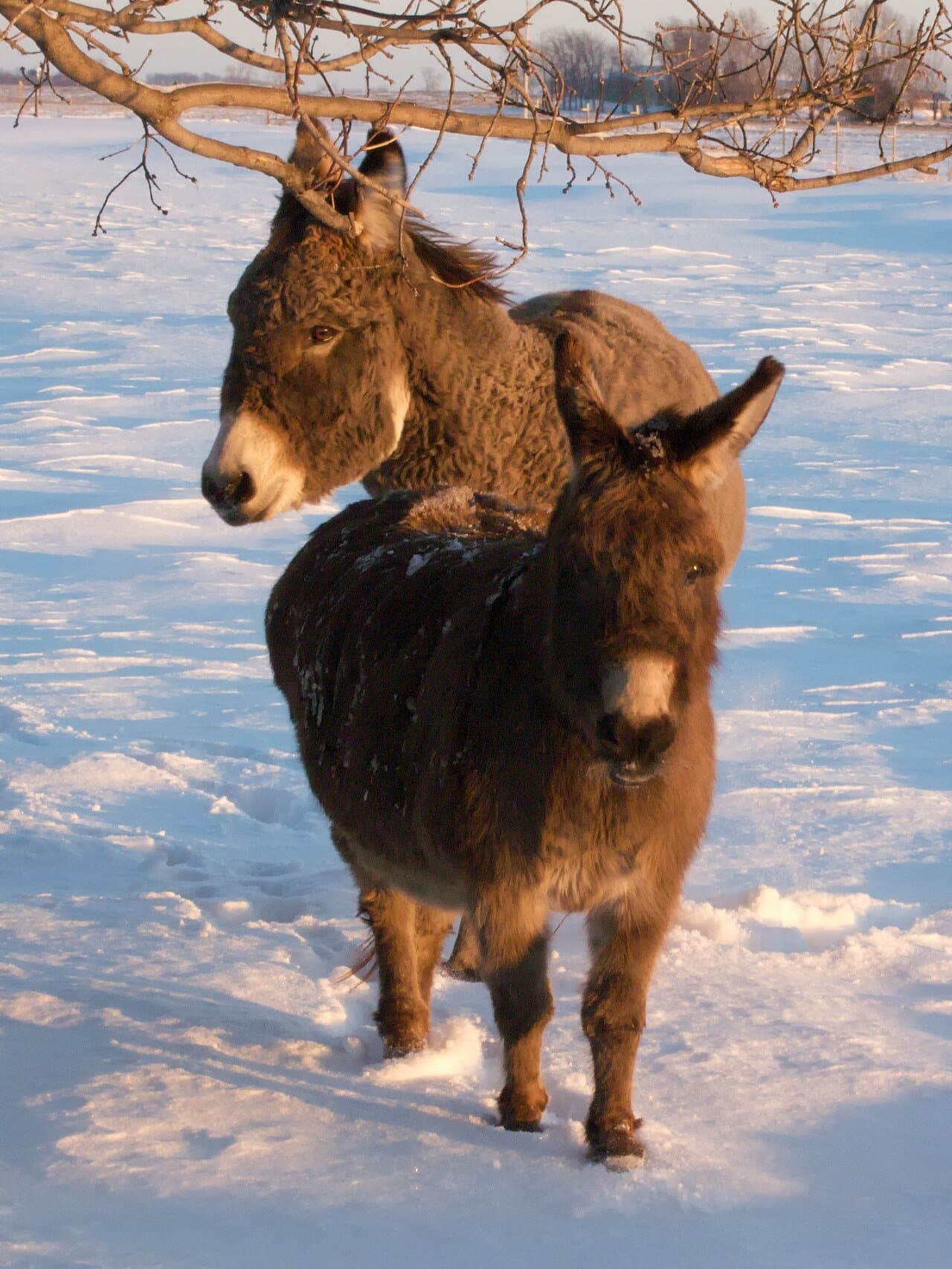
Miniature Donkey
Equus asinus (miniature breed)
A naturally small, gentle donkey from the Mediterranean islands of Sicily and Sardinia.
Checking teacher reviews…
About the Miniature Donkey
Miniature donkeys are no more than 36 inches tall at the shoulder and weigh 200 to 450 pounds. Their small size is natural, not bred down from larger donkeys. They come from the Mediterranean islands of Sicily and Sardinia and were first brought to the United States in 1929. Donkeys have large heads, long ears and cow-like tails. They graze on plants, grabbing them with their lips.[1]
Quick facts
- Scientific name
- Equus asinus (miniature breed)[1]
- Size
- No more than 36 inches tall at the shoulder.[1]
- Weight
- 200 to 450 pounds.[1]
- Lifespan
- Often into their 30s; average about 33 years.[1]
- Diet
- Herbivore. Grasses, hay and other plants.[1]
- Habitat
- Farms and pastures.[1]
- Where it lives
- Originally Sicily and Sardinia; now kept in many countries.[1]
- Group life
- Herds.[1]
- Babies
- One foal after about 12 months, weighing 18 to 25 pounds.[1]
- Conservation status
- Domestic breed. Not assessed by the IUCN.[1]
Fun facts
Vocabulary
- breed
- A group of domestic animals with a certain look, developed by people.
- domesticated
- Tamed and raised by people over many generations.
- bray
- The loud 'hee-haw' sound a donkey makes.
- foal
- A baby horse or donkey.
- herbivore
- An animal that eats only plants.
See it in person
- Smithsonian's National ZooWashington, D.C. · Kids' FarmSee this animal on the zoo's website ↗
These zoos had this animal when we gathered our information, but animals sometimes move. Check the zoo's website or contact the zoo before you visit.
Sources
- [1] Smithsonian's National Zoo & Conservation Biology Institute. “Miniature donkey.” https://nationalzoo.si.edu/animals/miniature-donkey (accessed 2026-10-08)
Facts last checked 2026-10-08.
More Farm Animals
 American BisonBison bison
 Babydoll Southdown SheepOvis aries
 Bactrian CamelCamelus bactrianus (domestic); wild relative Camelus ferus
 Black RhinocerosDiceros bicornis
 Chacoan PeccaryCatagonus wagneri
 ChickenGallus gallus domesticus
 Cochin ChickenGallus gallus domesticus
 CowBos taurus
 Domestic GoatCapra hircus
 Domestic RabbitOryctolagus cuniculus (domestic)
 Dromedary CamelCamelus dromedarius
 Greater One-Horned RhinocerosRhinoceros unicornis
 Guinea HogSus scrofa domesticus (Guinea hog breed)
 Guinea PigCavia porcellus
 Gulf Coast Native SheepOvis aries
 Huacaya AlpacaVicugna pacos
 Kunekune PigSus scrofa domesticus
 Nigerian Dwarf GoatCapra aegagrus hircus
 Nubian GoatCapra aegagrus hircus
 Oberhasli GoatCapra aegagrus hircus
 Plains ZebraEquus quagga (subspecies include Grant's zebra)
 Przewalski's HorseEquus ferus przewalskii
 Pygmy HippopotamusChoeropsis liberiensis
 Reticulated GiraffeGiraffa reticulata (also listed as Giraffa camelopardalis reticulata)
 Shetland SheepOvis aries (Shetland breed)
 Southern White RhinocerosCeratotherium simum simum
 TakinBudorcas taxicolor